ML Algorithms for MLOps

You can learn how ML Algorithms work from MLOps standpoint

Advanced Track · MLOps Specialization · Coming Soon

You can run a Random Forest or a GBM in production without thinking too hard. But when the model is a Transformer serving NLP at scale, a time series forecaster with seasonal drift, or a recommender system with feedback loops — the operational challenges are fundamentally different. This course closes the gap between knowing what advanced models are and knowing how to run them reliably in production.

  • Operate Transformers and NLP models — understanding their memory footprint, latency profile, and batching behavior at scale
  • Run time series forecasting and anomaly detection systems — with drift patterns specific to temporal models
  • Deploy and monitor recommender systems — handling feedback loops, popularity bias, and cold start in production
  • Apply probabilistic and Bayesian models — and know what uncertainty estimates mean for serving and monitoring
  • Apply the full model selection framework across all advanced model families for complex MLOps scenarios
Join Waitlist — Get Early Access Be first in line · Subscriber pricing at launch
🧠
5 Content ModulesTransformers to Bayesian
🛠️
7 Hands-on LabsReal production scenarios
🏁
Capstone Projectwith Instructor Review
🏆
Certificate of CompletionAdvanced Track credential
🎓
Senior / Lead LevelAdvanced Track · Coming Soon

Sound familiar?

You’ve deployed standard ML models. Now you’re being handed something you’ve never operated before.

Gradient boosting classifiers and simple neural networks have well-understood operational profiles. The models MLOps engineers are increasingly asked to run — large Transformers, time series forecasters, live recommender systems, and uncertainty-aware Bayesian models — behave differently in production in ways that require different monitoring, different infrastructure, and different incident response patterns.

🧊
“The Transformer model is cold-starting slowly and I don’t know why or how to fix it.”
Transformers have fundamentally different resource profiles from tabular models — large weights, tokenization overhead, attention computation that scales quadratically with sequence length, and cold-start costs that don’t exist for smaller models. Operating them well requires understanding these characteristics, not just deploying the artifact.
📈
“The time series forecasting model’s accuracy degrades after holidays and nobody knows why the alerts aren’t firing.”
Temporal models drift differently from static classifiers. Seasonal patterns, concept drift tied to calendar events, and distributional shift that looks like normal variance — these require drift monitoring strategies that don’t apply to tabular models. Standard PSI tests on a time series model will produce false alarms and miss real drift.
🔄
“The recommendation engine keeps amplifying popular items and nobody is tracking why.”
Recommender systems have feedback loops that no other model type has: the model influences user behaviour, which influences the data the model trains on, which changes what the model recommends. This isn’t drift in the traditional sense — it’s a production characteristic that requires specific monitoring for popularity bias, coverage collapse, and cold-start degradation.
This course was built to solve exactly that. Advanced Machine Learning Algorithms gives you the operational understanding of each advanced model family — their production behavior, resource profile, drift patterns, and failure modes — so you can monitor and manage them with the same confidence you bring to simpler models.

What makes this different

Not an ML research course.
Advanced model families explained for the engineer who runs them.

ML research courses explain how Transformers learn to attend, how Bayesian inference works mathematically, and how collaborative filtering converges. This course explains what Transformers cost to serve, how Bayesian uncertainty estimates affect monitoring, and what breaks in recommender systems when you deploy them at scale — from the perspective of the engineer responsible for keeping them running.

✓

Extends Course #3 without repeating it

ML Algorithms for MLOps (Course #3) covered the core families — Linear, Trees, GBMs, MLPs, CNNs, SVMs, Naive Bayes. This course covers the advanced families those engineers encounter next: Transformers, large NLP models, time series forecasters, anomaly detectors, recommender systems, and probabilistic models. Zero overlap.

✓

Consistent “Core Concepts → Use Cases → Ops Features → Lab” structure

Every module follows the same operational lens as Course #3: what the algorithm is, where it’s used in production, and how it behaves at scale. The Ops Features section — covering serving, latency, memory, monitoring, and failure modes — is what distinguishes this from a data science survey course.

✓

7 labs across production-realistic business scenarios

Sentiment analysis on customer reviews. Privacy-safe customer support. Energy demand prediction. Fraud detection in financial transactions. Movie recommendation with matrix factorization. Uncertainty-aware medical diagnosis. Model selection across three real-world case studies. These are not toy examples — they are the scenarios where advanced models appear in real production systems.

✓

Temporal and feedback-loop dynamics — what static models don’t have

Time series models drift with seasonal patterns that standard drift detectors miss. Recommender systems create feedback loops that amplify bias over time. This course covers the operational dynamics that are unique to these model types — because a monitoring strategy designed for a classifier won’t catch the failures that matter for a time series or recommender model.

✓

Privacy-aware NLP operations

The NLP lab is specifically framed as privacy-safe customer support — because NLP models in production almost always process sensitive text. Understanding what data the model sees, what it retains, and how to implement PII handling at the model layer is part of operating NLP models safely, not an afterthought.

✓

Extended model selection framework across all advanced families

The final module applies the same trade-off matrix from Course #3 to the full advanced model landscape — so you can reason across Transformers, time series, recommender, and probabilistic models when choosing the right approach for a senior-level MLOps scenario. Three real-world case studies anchor the framework to practice.

❌ ML / data science survey courses

—Focus on training accuracy and research benchmarks
—Transformers explained mathematically, not operationally
—Recommender systems as a recommendation problem, not a feedback-loop problem
—Probabilistic models as inference engines, not as uncertainty monitors

✓ Advanced Machine Learning Algorithms

→Focus on serving cost, drift, failure modes, and resource profiles
→Transformers: cold-start, tokenization overhead, batch size vs latency trade-offs
→Recommenders: popularity bias, coverage, cold start, and feedback loop monitoring
→Probabilistic: uncertainty estimates as production signals, not just model outputs

Learning outcomes

By the end of this course, you’ll be able to:

Six senior-level operational skills across five advanced model families — the knowledge that lets you confidently take on infrastructure responsibility for ML systems beyond standard classification and regression.

🤗 Transformers & NLP
✓
Operate Transformer and NLP models in production — understanding tokenization overhead, attention scaling, cold-start cost, and privacy implications of processing user text
Know what drives GPU memory usage in a Transformer, how batch size affects latency vs throughput, and how to implement PII-safe NLP serving for customer-facing applications.
📈 Time Series Forecasting
✓
Run time series forecasting models in production — with drift monitoring strategies that account for seasonality, calendar events, and temporal distribution shift
Know why standard PSI tests fail on time series data, how to set baseline windows that respect seasonality, and what operational patterns to watch for in a forecasting model serving energy, demand, or financial predictions.
🔍 Anomaly Detection
✓
Deploy anomaly detection systems for production ML pipelines — understanding their threshold behavior, false positive management, and operational differences from classifiers
Apply anomaly detection to fraud and operational monitoring scenarios — knowing how to tune thresholds for production false positive rates and what to monitor when the anomaly detector itself drifts.
🎯 Recommender Systems
✓
Operate recommender systems in production — monitoring for popularity bias, coverage collapse, cold-start degradation, and the feedback loops that make recommenders different from every other model type
Know what metrics to track beyond click-through rate, how to detect when a recommender is amplifying popular items at the expense of catalog coverage, and how to manage the cold-start problem for new users and new items.
🎲 Probabilistic & Bayesian
✓
Run probabilistic and Bayesian models in production — interpreting uncertainty estimates as operational signals and knowing what failure modes look like for models that express confidence
Understand what it means for a medical diagnosis model to express uncertainty, how to monitor calibration in production, and when wide uncertainty bands signal data distribution problems rather than model failures.
🎯 Advanced Model Selection
✓
Apply the extended model selection framework — choosing across all advanced model families for senior-level MLOps scenarios with complex requirements
Use the full trade-off matrix (covering both Course #3 and this course’s model families) to participate in architectural decisions about model type selection at the senior engineering level.

What you’ll learn

Course Curriculum

5 Content Modules
7 Hands-on Labs
1 Capstone Project
Senior Level
Adv. Track Optional
🗺️01
Introduction 7 lessonsContext, trends & setup
+
  • 📹 Course Introduction
  • 📹 About Your Instructor
  • 📹 Course Structure
  • 📹 Advanced ML Algorithms in Day-to-Day MLOps Activities
  • 📹 Global Usage Trends in ML Models
  • 📹 Overview of Advanced ML Models
  • 📹 GitHub Repositories
🤗02
Deep Learning Algorithms — Transformers & NLP 8 lessons🛠️ 2 hands-on labs
+
  • 📹 What is Deep Learning
  • 📹 What are Transformers
  • 📹 Examples of Transformers in Production
  • 📹 Ops Features of Transformers — Serving, Latency, Memory, Cold Start
  • 🛠️ Sentiment Analysis on Customer Reviews — Hands-on Lab
  • 📹 What are NLP Models
  • 📹 Examples of NLP Models in Production
  • 📹 Ops Features of NLP Models — Privacy, PII, Throughput
  • 🛠️ Privacy-Safe Customer Support NLP Pipeline — Hands-on Lab
📈03
Time Series & Anomaly Detection 8 lessons🛠️ 2 hands-on labs
+
  • 📹 What is Time Series & Anomaly Detection
  • 📹 What is Time Series Forecasting
  • 📹 Examples of Time Series Forecasting in Production
  • 📹 Ops Features of Time Series — Seasonal Drift, Baseline Windows, Alert Design
  • 🛠️ Energy Demand Prediction — Hands-on Lab
  • 📹 What is Anomaly Detection
  • 📹 Examples of Anomaly Detection in Production
  • 📹 Ops Features of Anomaly Detection — Thresholds, False Positives, Monitoring
  • 🛠️ Fraud Detection in Financial Transactions — Hands-on Lab
🎯04
Recommender Systems 4 lessons🛠️ Includes hands-on lab
+
  • 📹 What are Recommender Systems
  • 📹 Types of Recommender Systems — Collaborative, Content-Based, Hybrid
  • 📹 Examples of Recommender Systems in Production
  • 📹 Ops Features — Feedback Loops, Popularity Bias, Cold Start, Coverage
  • 🛠️ Movie Recommendation with Matrix Factorization — Hands-on Lab
🎲05
Other Useful Models — Probabilistic & Bayesian 4 lessons🛠️ Includes hands-on lab
+
  • 📹 What are Specialized Probabilistic Models
  • 📹 What are Probabilistic & Bayesian Models
  • 📹 Examples of Probabilistic & Bayesian Models in Production
  • 📹 Ops Features — Uncertainty Calibration, Inference Cost, Monitoring Confidence
  • 🛠️ Uncertainty-Aware Medical Diagnosis — Hands-on Lab
🎯06
Model Selection Framework — Advanced Edition 4 lessons🛠️ Includes hands-on lab
+
  • 📹 What Factors Should You Consider When Choosing an Advanced Model
  • 📹 Performance Aspects of Advanced ML Models in Production
  • 📹 MLOps Problems Specific to Each Advanced Algorithm Family
  • 📹 Trade-off Matrix for Advanced ML Models
  • 🛠️ Selecting Models for Three Real-World Case Studies — Hands-on Lab
🏁
Capstone Project with Instructor Review
Apply the advanced model selection framework and operational knowledge to a real MLOps scenario — selecting the right algorithm family, justifying the choice using the full trade-off matrix, and describing how you would run and monitor it in production. Reviewed by Alex with personal written feedback.
Included

Is this course right for you?

Built for experienced MLOps engineers who are starting to manage complex, high-impact model types

This is not a course for engineers new to MLOps. It’s for engineers who already know how to run standard ML models — and are now being handed Transformers, time series forecasters, recommender systems, or probabilistic models they’ve never operated before at scale.

⚙️
Mid-to-Senior MLOps Engineers
Own production responsibility for advanced model types
You’ve deployed classification and regression models confidently. Your team is now shipping Transformers, time series systems, and recommender engines. This course gives you the operational understanding of each advanced model family so you can manage them with the same confidence you bring to simpler models.
→ The Ops Features lesson for each model family is directly applicable to the infrastructure decisions you’ll make when these models go live.
🖥️
Platform & Infrastructure Engineers
Right-size infrastructure for advanced model needs
Transformer inference requires different GPU profiles than GBM serving. Recommender systems have different memory and latency characteristics than classifiers. Time series models need different scheduling patterns. This course gives you the model-family knowledge to make correct infrastructure decisions before a model goes into production.
→ The resource profile and ops features material gives you the vocabulary to collaborate with data science teams on infrastructure decisions for advanced models.
💻
Software Engineers in ML teams
Build serving and monitoring code for advanced model types
Serving a Transformer is not the same as serving a gradient boosting model. Monitoring a recommender requires tracking metrics that don’t exist for classifiers. This course teaches you the model-specific operational requirements that determine how you design serving endpoints, batch pipelines, and monitoring hooks for each advanced model type.
→ The hands-on labs for each model family give you working examples of the operational code for advanced model types.
📐
Tech Leads reviewing ML architecture decisions
Evaluate advanced model choices with operational authority
When a data scientist proposes a Transformer model for a latency-sensitive use case, or a recommender system for a dataset where cold start will be chronic — you need to know the operational implications before the architecture is committed. This course gives you the advanced model selection framework to evaluate those proposals with authority.
→ The Model Selection Framework module and the trade-off matrix are directly applicable to the architecture review conversations you lead.

Prerequisites — this course requires prior experience:

✓ You need
✓ ML Algorithms for MLOps (Course #3) — or equivalent algorithm knowledge
✓ MLOps Fundamentals (Course #1) — field context
✓ Working experience operating ML models in production
✓ Python confidence and familiarity with ML serving patterns
✗ If you’re new to MLOps algorithms
→ That course covers Linear, Trees, GBMs, basic Deep Learning, SVMs — the foundation this course builds on
→ This advanced course won’t re-explain concepts covered in Course #3

MLOps Specialization — Advanced Track

Optional deep-dive for experienced engineers

Advanced Machine Learning Algorithms is not Course #4 in the main progression — it’s an optional advanced course designed for engineers who want to go deeper on algorithm families after completing Course #3 (ML Algorithms for MLOps). Take it any time after Course #3.

Core Specialization Path

1
MLOps Fundamentals
Available Now →
2
Python for MLOps
Available Now →
4
ML Model Lifecycle (Coming Soon)
5–8
CI/CD, Data, Observability, Security (Coming Soon)

Advanced Track (Optional)

🐍
Advanced Python for MLOps
Decorators, concurrency, ML APIs, Parquet, Cloud SDKs. Takes after Course #2.
Coming Soon · View page →
🧠
Advanced ML Algorithms
You are here
Transformers, NLP, time series, recommender systems, probabilistic models. Takes after Course #3.
More advanced optional courses are being developed for Senior and Lead MLOps engineers. Subscribe to get notified when they launch.
💡 When to take this: After completing ML Algorithms for MLOps (Course #3) or equivalent algorithm experience. Can be taken alongside or after any core specialization course from Course #4 onwards.

Advanced ML Algorithms is the fastest path from “I can operate standard models” to “I can operate any model type in production.”

Join Waitlist — Get Early Access

What engineers say after completing this course

⭐⭐⭐⭐⭐   Verified student reviews – 100% five-star

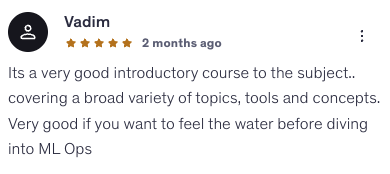
  • 5-star student review screenshot 🔍 View
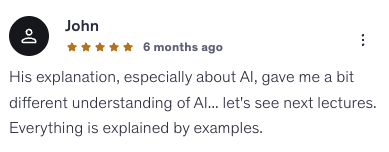
  • 5-star student review screenshot 🔍 View
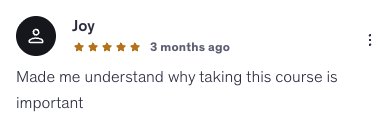
  • 5-star student review screenshot 🔍 View
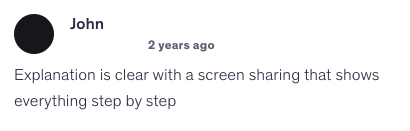
  • 5-star student review screenshot 🔍 View
  • 5-star student review screenshot 🔍 View
✕ ‹
›

Coming soon · Advanced Track

Be first when Advanced Machine Learning Algorithms launches

Join the waitlist to secure subscriber pricing and get notified the moment the course goes live. Everything planned, confirmed from the curriculum draft:

  • 🧠
    5 content modules — five advanced model families Transformers & NLP, Time Series & Anomaly Detection, Recommender Systems, Probabilistic/Bayesian, and the Advanced Model Selection Framework.
  • 🛠️
    7 hands-on labs — real production business scenarios Sentiment analysis, privacy-safe NLP, energy demand forecasting, fraud detection, movie recommendation, medical diagnosis, and model selection case studies.
  • 🏁
    Capstone project with instructor review Apply the advanced model selection framework to a real MLOps scenario — reviewed by Alex with personal written feedback.
  • 🏆
    Certificate of Completion — Advanced Track Shareable on LinkedIn and CV. Advanced Track credential for the MLOps Specialization.
🏢
Training your senior engineering team?
Let us know your team’s size — we’ll include you in early access planning. Contact us →
Advanced ML Algorithms · Advanced Track
Price: coming soon
Subscriber pricing for waitlist members at launch
💡 Waitlist members receive a subscriber discount off the public launch price. No commitment required.
Join the Waitlist — Free
No commitment · First access + subscriber pricing
  • ✓ 5 content modules confirmed
  • ✓ 7 hands-on labs
  • ✓ Capstone + instructor review
  • ✓ Certificate of Completion
  • ✓ Advanced Track credential
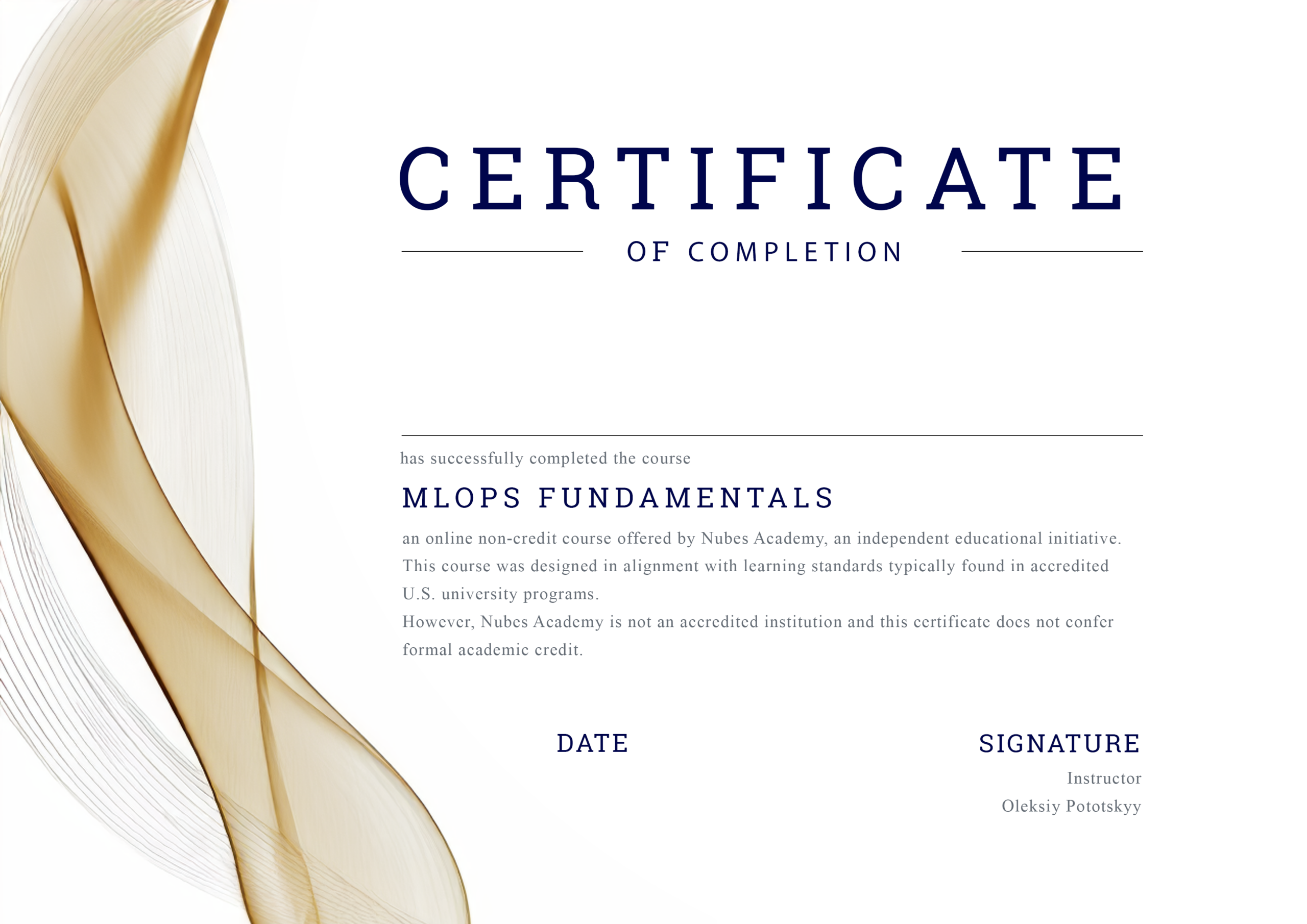
Machine Learning Algorithms for MLOps - Certificate of Completion

Course credential

Certificate of Completion

Complete the course and earn a Certificate of Completion in Advanced Machine Learning Algorithms for MLOps — shareable directly to your LinkedIn profile and CV. For engineers moving into senior MLOps roles, demonstrating operational knowledge of advanced model types — Transformers, time series, recommender systems — is a significant differentiator from engineers who only manage standard tabular models.

This certificate is part of the Advanced Track of the MLOps Specialization. Nubes Academy is developing university accreditation partnerships for the full specialization — the credentials you build today are designed to grow into something recognized beyond a standard online course certificate.

🧠 Advanced Track · MLOps Specialization Complete the core specialization and advanced track courses to build a comprehensive, verifiable MLOps credential portfolio covering both standard and advanced model operation.
Alex Pototskyy - Founder, Nubes Academy

Your instructor

About Your Instructor

Alex is an Independent Consultant with 20+ years of experience across Software development, DevOps, Architecture, and technical leadership. He developed and delivered Cloud & DevOps curriculum at Master’s Degree level at a university, and continues to work as an active practitioner alongside building Nubes Academy.

What makes Alex’s approach different: his courses are built from data, not assumptions. The MLOps Fundamentals curriculum was designed by analysing what MLOps engineers actually do in production, not by following a generic textbook outline. The result is a course that covers what your future employer expects, explained in a way that makes sense if you already think like an engineer.

If you have a background in IT, and you want to understand where ML fits into the systems you already work with – this course was built for exactly where you are.


Got questions?

Frequently asked questions

The course is currently in development. Join the waitlist to be notified as soon as it’s available — waitlist members receive subscriber pricing at launch. We don’t publish a date until the course passes our quality review.
Zero content overlap. Course #3 covers the core algorithm families: Linear Models, Decision Trees, GBMs, basic Deep Learning (MLPs, CNNs), SVMs, and Naive Bayes. This advanced course covers the families Course #3 didn’t: Transformers, large NLP models, Time Series Forecasting, Anomaly Detection, Recommender Systems, and Probabilistic/Bayesian models. The two courses together cover the full landscape of model families that MLOps engineers encounter in modern production systems.
ML Algorithms for MLOps (Course #3) is the primary prerequisite — this course builds directly on the operational framework and model selection methodology established there. You should be comfortable with the “Core Concepts → Where It’s Used → Ops Features → Lab” structure from Course #3, and with basic operational concepts like latency profiles, resource footprints, and drift monitoring, before starting this advanced course.
This is an optional advanced course in the Advanced Track of the MLOps Specialization — not part of the core numbered progression (Courses #1–#8). You can take it any time after Course #3, alongside or after any core specialization courses. It’s designed for engineers who want deeper algorithm knowledge beyond what the core path covers, particularly those managing complex high-impact models in production.
Seven labs covering real production scenarios: (1) Sentiment analysis on customer reviews — Transformer serving, (2) Privacy-safe customer support NLP pipeline — PII handling in text model serving, (3) Energy demand prediction — time series forecasting with seasonal patterns, (4) Fraud detection in financial transactions — anomaly detection deployment, (5) Movie recommendation with matrix factorization — recommender system with feedback loop monitoring, (6) Uncertainty-aware medical diagnosis — probabilistic model serving, (7) Model selection for three real-world case studies using the advanced trade-off matrix.
No significant overlap. Course #3’s Deep Learning module covered MLPs (feedforward networks) and CNNs — the foundational architectures used in tabular and image classification tasks. This course’s Deep Learning module covers Transformers and large NLP models — architectures with fundamentally different operational profiles: much larger memory footprints, tokenization overhead, attention computation that scales with sequence length, and different cold-start dynamics. The operational challenges are distinct enough that this content doesn’t overlap meaningfully with Course #3.
Yes — you receive a Certificate of Completion in Advanced Machine Learning Algorithms for MLOps shareable on LinkedIn and your CV. This is an Advanced Track credential — it complements the core specialization but isn’t required to earn the full MLOps Specialization Certificate (which requires Courses #1–#8). Engineers who complete both Course #3 and this advanced course will have full coverage of the algorithm landscape that production ML systems use.
Yes. Team licenses for 5–20 engineers will be available, with a manager progress dashboard and kickoff session. This course is particularly valuable for teams where different engineers operate different advanced model types — Transformers, recommenders, time series — and benefit from shared operational vocabulary and monitoring frameworks across model families. Contact [email protected] to be included in early team pricing discussions.

Still have questions? Email us directly — we reply within 1–2 business days.

It’s not just skills. It’s your next chapter.

Stay ahead

New courses.
Better price.
Subscribers first.

  • Subscriber-only discount on every new course in the MLOps Specialization – before public launch price applies
  • Early access to new courses when they go live.
  • MLOps job market insights – what skills employers are actually hiring for, based on real job description data
  • Practical guides & free content – no noise, only what matters for engineers moving into MLOps

Get early access & subscriber discounts No spam. Unsubscribe any time.

Subscription Form

Your data is stored securely and never shared with third parties.  ·  Privacy Policy