ML Algorithms for MLOps
You can learn how ML Algorithms work from MLOps standpoint
MLOps engineers work with models every day, but most can’t explain how Linear Regression differs from a Gradient Boosting Machine in production, or why a CNN consumes ten times more GPU memory than an MLP. This course closes that gap. Real ML algorithms explained for the engineers who run them – not the data scientists who train them.
- Understand what each major algorithm family does and where it’s used in production
- Know the resource footprint, latency profile, and monitoring needs of each model type
- Run 9 hands-on labs across real business scenarios – churn, fraud, defect detection, spam
- Apply a model selection framework to choose the right algorithm for any MLOps scenario
- Speak confidently about model choice in architecture reviews and team conversations
Sound familiar?
You work with ML models every day, but you can’t explain what’s inside them.
MLOps engineers deploy, monitor, and maintain models that were built by data scientists. The problem: when something goes wrong, when resource costs spike, or when someone asks why a particular model was chosen – you need to know what you’re running. Most engineers don’t. That knowledge gap is expensive.
What makes this different
Not an ML course.
An MLOps engineer’s guide to ML algorithms.
Data science courses teach you how to train models. This course teaches you how to run, monitor, and choose them – the perspective of the engineer in production, not the researcher in the notebook.
Every algorithm taught through an operational lens
For each algorithm family: what it is, where it’s used in production, and how to run and monitor it. The “Core Concepts → Where It’s Used → Running and Monitoring → Hands-on Lab” pattern is consistent across every module.
9 hands-on labs with real business datasets
Customer churn, loan approval, credit risk scoring, customer segmentation, product recommendation embeddings, sales prediction, manufacturing defect detection, legal document classification, spam filtering – real scenarios, not toy examples.
A model selection framework you can use immediately
The final module gives you a practical decision framework — performance trade-offs, MLOps-specific problems per algorithm, a trade-off matrix, and three real-world case studies where you choose the right model.
No math, no training code
No gradient descent derivations, no loss function proofs, no building models from scratch. You’ll understand how each algorithm works at the level an MLOps engineer needs – enough to reason about behaviour, resources, and failure modes.
Covers all major algorithm families
Supervised (Linear, Trees, GBMs), Unsupervised (Clustering, Dimensionality Reduction), Deep Learning (MLPs, CNNs), and Specialized (SVMs, Naive Bayes) – a complete map of the algorithms you’ll encounter in production ML systems.
Builds directly on Courses #1 and #2
MLOps Fundamentals gave you the field overview. Python for MLOps gave you the coding foundation. This course gives you the algorithm knowledge that the deeper specialization courses – CI/CD, Model Lifecycle, Observability – assume you have.
❌ Data science / ML courses
✓ ML Algorithms for MLOps
Learning outcomes
By the end of this course, you’ll be able to:
Six operational skills across every major ML algorithm family – the knowledge that separates an MLOps engineer from a generic DevOps engineer supporting ML systems.
What you’ll learn
Course Curriculum
Introduction
+
- Course Introduction
- About Your Instructor
- Course Structure
- ML Algorithms in Day-to-Day Activities of MLOps
- Global Usage Trends in ML Models
- Course Materials
Supervised Learning Algorithms
+
- What is Supervised Learning
- Linear Models: Core Concepts
- Where Linear Models Are Used
- Running and Monitoring Linear Models
- Customer Churn Prediction — Hands-on Lab
- Decision Trees & Random Forests: Core Concepts
- Where Decision Trees & Random Forests Are Used
- Running and Monitoring Decision Trees & Random Forests
- Loan Approval Classification — Hands-on Lab
- Gradient Boosting Machines (GBMs): Core Concepts
- Where Gradient Boosting Machines Are Used
- Running and Monitoring Gradient Boosting Machines
- Credit Risk Scoring System — Hands-on Lab
- Quiz — Supervised Learning Algorithms
Unsupervised Learning Algorithms
+
- What is Unsupervised Learning
- Clustering: Core Concepts
- Where Clustering Is Used
- Running and Monitoring Clustering
- Customer Segmentation — Hands-on Lab
- Dimensionality Reduction: Core Concepts
- Where Dimensionality Reduction Is Used
- Running and Monitoring Dimensionality Reduction
- Visualization of Product Recommendation Embeddings — Hands-on Lab
- Quiz — Unsupervised Learning Algorithms
Deep Learning Algorithms
+
- What is Deep Learning
- Feedforward Networks (MLPs): Core Concepts
- Where Feedforward Networks (MLPs) Are Used
- Running and Monitoring Feedforward Networks (MLPs)
- Predicting Sales from Tabular Features — Hands-on Lab
- Convolutional Neural Networks (CNNs): Core Concepts
- Where Convolutional Neural Networks (CNNs) Are Used
- Running and Monitoring Convolutional Neural Networks (CNNs)
- Manufacturing Defect Detection — Hands-on Lab
- Quiz — Deep Learning Algorithms
Other Useful Models
+
- What are Specialized Models
- SVMs: Core Concepts
- Where SVMs Are Used
- Running and Monitoring SVMs
- Classifying Legal Documents — Hands-on Lab
- Naive Bayes: Core Concepts
- Where Naive Bayes Are Used
- Running and Monitoring Naive Bayes
- Spam Filtering — Hands-on Lab
- Quiz — Other Useful Models
Model Selection Framework
+
- What Factors Should You Consider When Choosing the Right Model
- Performance Aspects of Different ML Models
- MLOps Problems Related to Specific Algorithms
- Trade-off Matrix for ML Models
- Selecting Models for Three Real-World Case Studies — Hands-on Lab
Is this course right for you?
Built for engineers who run ML models – not engineers who build them
You don’t need to be a data scientist. You need to understand what every model type is doing in production, so you can plan infrastructure, interpret monitoring, and participate in model selection conversations.
Prerequisites — what you need before starting:
✓ You need
✗ You do NOT need
MLOps Specialization path
This is Course #1 of the full
MLOps Specialization
Each course builds on the previous one. Start here to get your field overview – then go as deep as your career requires.
Start with MLOps Fundamentals and decide your next step based on your career goals.
Start with Course #1 – Enroll NowWhat engineers say after completing this course
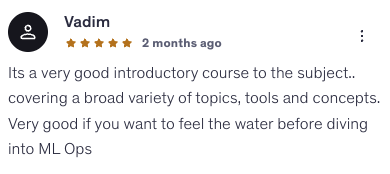
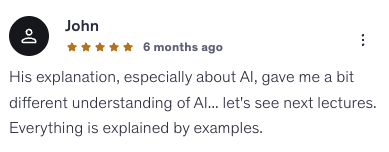
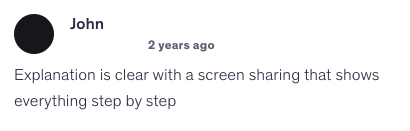
⭐⭐⭐⭐⭐ Verified student reviews – 100% five-star
-
 🔍 View
-
 🔍 View
-
 🔍 View
-
 🔍 View
-
 🔍 View
Enroll today
Everything you need to understand and operate ML models in production
One payment. 2 years access. Six modules, 51 lectures, 9 hands-on labs, and a model selection framework you’ll use for the rest of your career.
-
51 Lectures · 4h 30m of video Stream on any device, any time. Rewatch at your pace.
-
9 Hands-on labs · 5 practical quizzes Real business datasets — churn, credit risk, defect detection, spam, segmentation, and more.
-
Capstone project with instructor review Personal feedback from Alex on your algorithm selection and implementation approach.
-
Model selection framework A practical trade-off matrix and decision process for choosing the right algorithm for any scenario.
-
Lesson-level Q&A access Ask questions on any lesson – answered in context by the instructor.
-
Certificate of Completion Share to LinkedIn and CV. Step 3 of the MLOps Specialization credential path.
- ✓ 51 lectures · 4h 30m video
- ✓ 9 hands-on labs
- ✓ Capstone + instructor review
- ✓ Model selection framework
- ✓ Certificate of Completion
- ✓ 2 years access
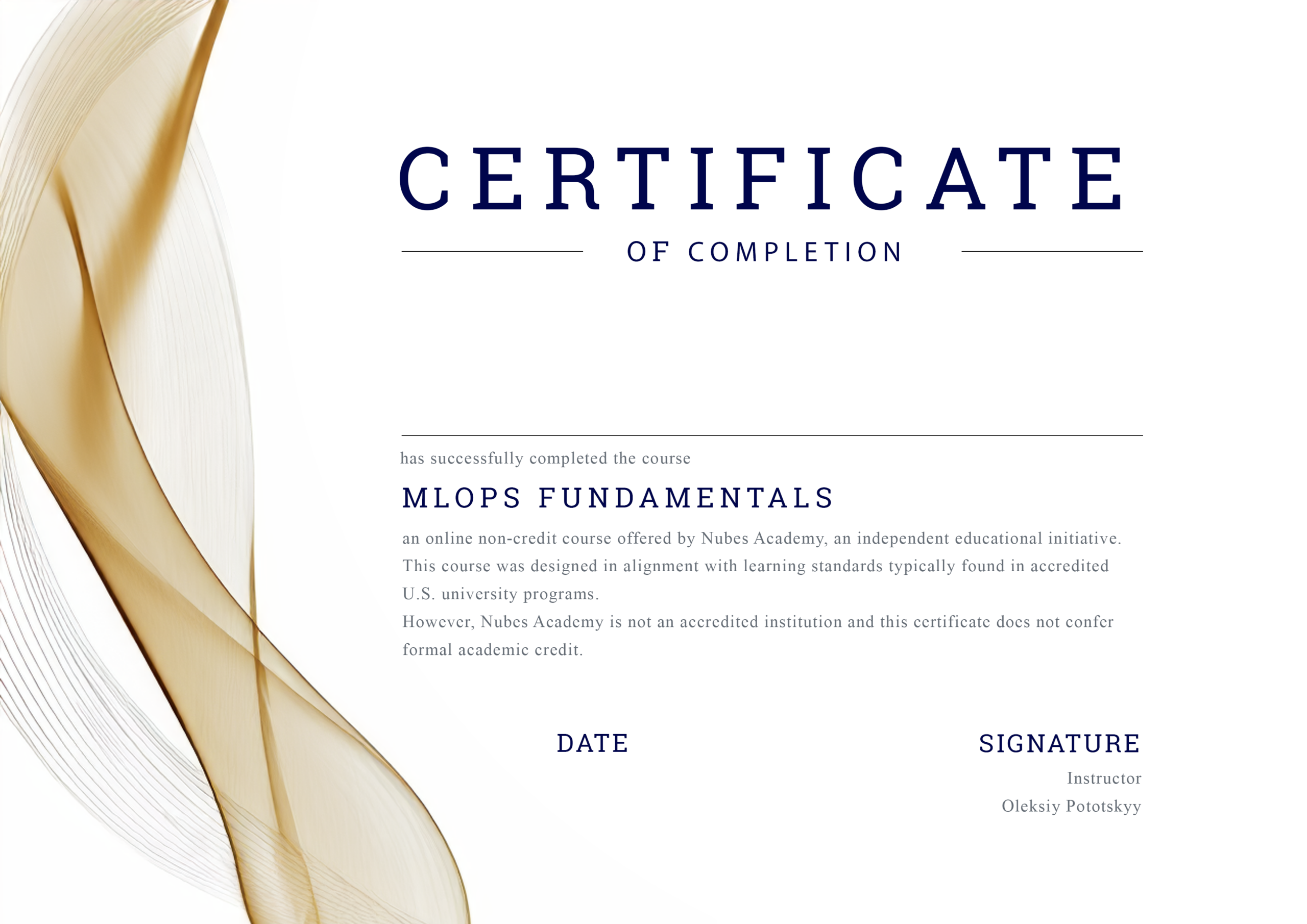
Course credential
Certificate of Completion
Complete the course and earn a Certificate of Completion in Machine Learning Algorithms for MLOps – shareable directly to your LinkedIn profile and CV. For engineers building a case for a role change or promotion, demonstrating operational ML knowledge in a high-demand field carries real weight.
This certificate is also Step 3 of the MLOps Specialization path. Nubes Academy is developing university accreditation partnerships for the full specialization – the credential you build today is designed to grow into something recognized beyond a standard online course certificate.

Your instructor
About Your Instructor
Alex is an Independent Consultant with 20+ years of experience across Software development, DevOps, Architecture, and technical leadership. He developed and delivered Cloud & DevOps curriculum at Master’s Degree level at a university, and continues to work as an active practitioner alongside building Nubes Academy.
What makes Alex’s approach different: his courses are built from data, not assumptions. The MLOps Fundamentals curriculum was designed by analysing what MLOps engineers actually do in production, not by following a generic textbook outline. The result is a course that covers what your future employer expects, explained in a way that makes sense if you already think like an engineer.
If you have a background in IT, and you want to understand where ML fits into the systems you already work with – this course was built for exactly where you are.
Got questions?
Frequently asked questions
Still have questions? Email us directly — we reply within 1–2 business days.
It’s not just skills. It’s your next chapter.
Stay ahead
New courses.
Better price.
Subscribers first.
- Subscriber-only discount on every new course in the MLOps Specialization – before public launch price applies
- Early access to new courses when they go live.
- MLOps job market insights – what skills employers are actually hiring for, based on real job description data
- Practical guides & free content – no noise, only what matters for engineers moving into MLOps
Get early access & subscriber discounts No spam. Unsubscribe any time.
Your data is stored securely and never shared with third parties. · Privacy Policy