Course #2 of MLOps Specialization

Python as MLOps glue language vs. MLOps field overview

Course #2 of MLOps Specialization

Python is the language that holds MLOps together – data pipelines, testing, serialization, logging, automation. But most Python courses teach the programming language in general. This course teaches only what MLOps engineers actually use. Practical, focused, and built around real ML workflows – not toy examples.

  • Write Python the way MLOps engineers write it – structured, reliable, readable
  • Work with files, configs, environments, and OS operations in ML contexts
  • Build logging, error handling, and testing into your Python code from day one
  • Process data with NumPy and Pandas in real MLOps pipeline patterns
  • Know exactly what Python skills each deeper specialization course requires
Enroll Now One-time payment · € 129,00 · 2 years access with extension available
🎬
72 Lectures4+ Hours of Video
📝
15 Practical QuizzesOne per module
🏆
Certificate of CompletionShareable on LinkedIn & CV
💬
Lesson-level Q&ADedicated GitHub Project
🐍
MLOps-focused Python onlyCourse #2 · MLOps Specialization

Sound familiar?

You know Python, but not the way MLOps uses it.

Most IT and DevOps professionals have written Python scripts. But writing MLOps-grade Python – structured, testable, production-ready code that slots into real ML pipelines – is a different skill entirely. The gap shows up fast when you join an ML team.

🤯
“I can write scripts but not production Python.”
You get things working, but the code is hard to read, impossible to test, and breaks when anyone else touches it. MLOps codebases need a different level of structure.
📚
“General Python courses don’t cover what I need.”
You’ve done Python courses. They taught you OOP and web frameworks. None of them covered logging, serialization, pytest patterns, or NumPy in the way MLOps actually uses them.
🔍
“I can’t read ML pipeline code confidently.”
You open a real MLOps codebase and see environment variables, YAML configs, custom loggers, and pytest fixtures. You know Python, but not this Python.
This course was built for exactly that gap. Python for MLOps covers only the Python patterns that appear in real ML workflows – nothing more, nothing less. Every concept is taught through MLOps use cases so you can apply it immediately to actual systems.

What makes this different

Not another Python tutorial.
Python as it’s used in real ML systems.

Most Python courses try to cover the entire language or focus on web development. This course covers only what you need to write, test, and maintain Python code inside real MLOps workflows.

✓

MLOps-only scope – zero filler

No web frameworks, no GUI programming, no academic exercises. Every topic – logging, testing, serialization, NumPy, Pandas – is taught through an MLOps lens with real use cases.

✓

Real codebase, not toy examples

All examples come from actual ML pipeline patterns. The dedicated GitHub project gives you production-style Python code you can reference and reuse in your own work.

✓

Built for engineers, not data scientists

Assumes you already think like an engineer – you understand systems, terminals, and version control. We skip the basics and go straight to what matters for MLOps roles.

✓

Covers the Python others skip

Most courses skip logging, environment variable management, serialization with YAML and Pickle, and proper pytest patterns. These are exactly what MLOps engineers write every day.

✓

NumPy and Pandas for operators

You’ll learn data processing from the perspective of someone who runs pipelines – how to load, validate, transform, and export data – not how to build ML models.

✓

Part of the MLOps Specialization path

This is Course #2 in the MLOps Specialization. The Python skills you build here are the exact foundation the deeper courses – CI/CD, Model Lifecycle, Observability – are built on.

❌ Generic Python courses

—Cover the full language from scratch including irrelevant topics
—Examples focus on web apps, scripts, or algorithms
—Skip logging, serialization, environment management
—Testing is an afterthought, not a workflow pattern

✓ Python for MLOps

→Covers only what MLOps engineers actually use
→All examples from real ML pipeline and infrastructure code
→Dedicated modules on logging, YAML, JSON, Pickle, pathlib
→pytest patterns taught as a first-class MLOps skill

Learning outcomes

By the end of this course, you’ll be able to:

Six concrete Python skills you’ll carry into every MLOps role, code review, and production deployment from day one.

🐍 Core Python
✓
Write clean, structured Python code used in real MLOps projects
Read, understand, and contribute to production ML codebases – not just write scripts that work on your machine.
📦 Serialization
✓
Read, write, and manage configs and serialized data – JSON, YAML, and Pickle model files
Handle the data formats that every MLOps pipeline uses: model artifacts, config files, experiment parameters, and pipeline metadata.
🗂️ File & OS
✓
Work with files, paths, environment variables, and OS operations in ML workflows
Navigate real ML project directory structures, manage secrets via environment variables, and run shell commands from Python the right way.
🪵 Logging & Errors
✓
Use logging and error handling to build reliable, observable ML-related services
Instrument your Python code the way production ML services do – structured logs, proper exception handling, and debuggable outputs.
🧪 Testing
✓
Write and understand tests for Python code used in ML systems – unittest and pytest patterns
Understand and write the tests that CI/CD pipelines run against ML code – fixtures, parameterized tests, and assertions on data shapes.
📊 NumPy & Pandas
✓
Work with NumPy and Pandas for data processing in MLOps pipelines
Load, validate, transform, and export datasets through the data-processing patterns that every real MLOps pipeline depends on.

What you’ll learn

Course Curriculum

13 Modules
72 Lectures
4h+ Video
15 Quizzes
1 GitHub Project
🐍01
Introduction 10 lessonsSetup & environment
+
  • 📹 Course Introduction
  • 📹 About Your Instructor
  • 📹 Course Structure
  • 📹 What is Python
  • 📹 Python vs Other Programming Languages
  • 📹 GitHub Repositories with MLOps Projects
  • 📹 Getting Started & Setting Up Your Lab
  • 📹 Python Installation (Windows / Linux / macOS)
  • 📹 Required Python Libraries for This Course
  • 📹 Additional Tools
⚙️02
Core Python Basics 12 lessons📝 Quiz included
+
  • 📹 Basic Syntax
  • 📹 Basic Data Types
  • 📹 Strings
  • 📹 F-strings and String Formatting
  • 📹 Collections
  • 📹 Naming Conventions
  • 📹 Scope & Namespaces
  • 📹 Control Flow and Logic
  • 📹 Comparison Operators
  • 📹 Conditional Statements
  • 📹 Iteration and Loops
  • 📹 List Comprehensions
🔧03
Functions, Typing & Text Processing 5 lessons📝 Quiz included
+
  • 📹 Function Definition Syntax
  • 📹 Lambda Functions
  • 📹 Typing and Linting
  • 📹 Finding Text Patterns
  • 📹 Regular Expressions
📦04
Modules & Packages 4 lessons📝 Quiz included
+
  • 📹 Creating Modules & Packages
  • 📹 Standard Modules
  • 📹 Packages
  • 📹 Third-party Packages
🏗️05
Classes & Object-Oriented Programming 6 lessons📝 Quiz included
+
  • 📹 OOP Basic Concepts
  • 📹 Class Definition Syntax
  • 📹 Object Lifecycle (__init__, __del__)
  • 📹 Attributes & @property
  • 📹 Methods, @classmethod & @staticmethod
  • 📹 Class Objects
⚠️06
Exceptions & Error Handling 4 lessons📝 Quiz included
+
  • 📹 Handling Exceptions (try / except / else / finally)
  • 📹 Built-in Exceptions
  • 📹 User-defined Exceptions
  • 📹 Raising Exceptions
🗂️07
File & OS Operations 5 lessons📝 Quiz included
+
  • 📹 File I/O
  • 📹 Context Managers
  • 📹 Working with Paths (pathlib)
  • 📹 Environment Variables
  • 📹 Subprocess & Shell Commands
🪵08
Logging 2 lessons📝 Quiz included
+
  • 📹 Basic Logging
  • 📹 Logging Levels
💾09
Serialization 4 lessons📝 Quiz included
+
  • 📹 Introduction to Serialization
  • 📹 Working with JSON
  • 📹 Working with YAML
  • 📹 Pickle and Model / Object Serialization
🧪10
Testing 6 lessons📝 Quiz included
+
  • 📹 Introduction to Testing
  • 📹 Testing Conventions
  • 📹 Using unittest and pytest
  • 📹 Writing Test Classes vs. Test Functions
  • 📹 Parameterizing Tests
  • 📹 Using plain assert in pytest
🔢11
Numeric Data with NumPy 4 lessons📝 Quiz included
+
  • 📹 Introduction to NumPy
  • 📹 Creating and Manipulating Arrays
  • 📹 Array Indexing, Slicing, and Reshaping
  • 📹 Vectorized Operations and Basic Math
📊12
Data Analysis with Pandas 7 lessons📝 Quiz included
+
  • 📹 Introduction to Pandas
  • 📹 Loading Data with Pandas
  • 📹 Exploring and Inspecting DataFrames
  • 📹 Transforming and Cleaning Data
  • 📹 Exporting DataFrames to Files
  • 📹 Applying Functions and Simple Data Validation
  • 📹 Quick Visualization with Pandas
🔌13
External Libraries 3 lessonsConfig & HTTP clients
+
  • 📹 Config & Structured Data (INI / TOML / YAML)
  • 📹 HTTP Clients (requests, httpx)
  • 📝 Final Quiz — External Libraries

Is this course right for you?

Built for IT professionals
ready to enter the MLOps field

You don’t need a data science background. You need IT experience and the ambition to grow into one of the most in-demand roles in tech.

⚙️
DevOps Engineers
Most direct path to MLOps
You already understand CI/CD, containers, and infrastructure. MLOps is DevOps applied to machine learning — and it pays significantly more. The transition is shorter than you think.
→ Your existing skills transfer directly. This course shows you exactly what’s new and different in the ML world.
🖥️
System Administrators
From ops to AI infrastructure
Deep knowledge of servers, networking, and cloud gives you a strong foundation. As companies scale their ML systems, they need engineers who can manage the infrastructure side — that’s you, upgraded.
→ Learn how ML models behave differently in production and what new operational challenges they create.
💻
Software Engineers & ML Developers
Build better ML systems
Whether you’re writing code alongside ML teams or building ML models yourself, understanding how models are deployed, versioned, monitored, and retrained makes you a significantly more valuable engineer.
→ Understand what happens after model training — and build systems that actually work in production.

Prerequisites — what you need before starting:

✓ You need
✓ Linux basics (terminal, file system)
✓ Basics of Git (clone, commit, push)
✓ Basic software development concepts (Python helpful, not required)
✗ You do NOT need
✗ Data science or statistics background
✗ Experience training ML models
✗ Prior MLOps knowledge
✗ Math beyond basic programming logic

MLOps Specialization path

Your complete MLOps career roadmap

Python for MLOps is Course #2 – built on the field overview from Course #1 and the foundation for every deeper course that follows.

1
Available now
MLOps Fundamentals
Full-field observability: AI/ML landscape, model lifecycle, CI/CD, infrastructure, monitoring, security, cost, and career paths – with real examples and a GitHub project.
2
▶ You are here – Available now
Python for MLOps Current Course
Practical Python skills for MLOps contexts – scripting pipelines, working with APIs, handling data, and automating ML workflows. No data science prerequisites
3
Available now
Machine Learning Algorithms for MLOps
The most widely used ML algorithms explained for engineers who operate them, not develop them – behavior in production, resource footprint, and deployment characteristics for each model type.
4
Coming soon
Machine Learning Model Lifecycle
From experiment to production: model versioning, registry management, staging environments, promotion gates, drift detection, and automated retraining pipelines.
5
Coming soon
CI/CD for MLOps
Build ML pipelines from scratch: data CI, training CI, model packaging, container builds, registry promotion, deployment pipelines, safe rollouts, and LLM CI/CD – validated against 1k+ real job descriptions.
6
Coming soon
Data for MLOps
Data pipelines, quality contracts, versioning, lineage tracking, and feature stores – the data infrastructure layer that makes ML models reliable in production.
7
Coming soon
MLOps Observability & Monitoring
Production monitoring for ML systems: model performance dashboards, drift detection, alerting strategies, SLOs for ML services, and incident response for model failures.
8
Coming soon
MLOps Security & Compliance
Supply chain security for ML systems, model governance, access control, compliance frameworks, and SecOps practices applied to ML infrastructure and pipelines.
🎓
Specialization goal
MLOps Specialization Certificate
Nubes Academy is developing university accreditation partnerships. The specialization is designed to qualify as a recognized credential – not just another online certificate.

You’re in the right place. Complete Course #2 and the full specialization opens up.

Enroll in Python for MLOps Now

What engineers say after completing this course

⭐⭐⭐⭐⭐   Verified student reviews – 100% five-star

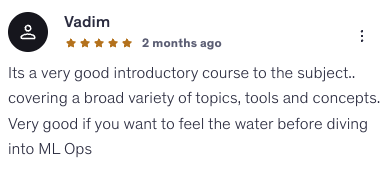
  • 5-star student review screenshot 🔍 View
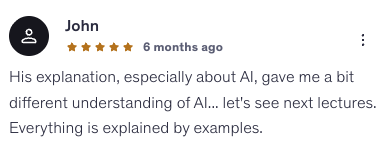
  • 5-star student review screenshot 🔍 View
  • 5-star student review screenshot 🔍 View
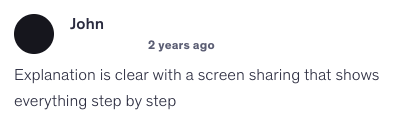
  • 5-star student review screenshot 🔍 View
  • 5-star student review screenshot 🔍 View
✕ ‹
›

Enroll today

Everything you need to write Python for real ML systems

One payment. 2 years access with extension available. All 13 modules, 72 lectures, and a GitHub project with production-style Python code you can reuse immediately.

  • 🎬
    72 Lectures · 4+ hours of video Stream on any device, any time. Rewatch at your pace.
  • 📝
    15 Practical quizzes One per module – test your understanding at each stage.
  • 💻
    Dedicated GitHub project Production-style Python code to explore, clone, and reuse in your own work.
  • 💬
    Lesson-level Q&A access Ask questions on any lesson – answered in context by the instructor.
  • 🌐
    English subtitles Full subtitle support for non-native English speakers.
  • 🏆
    Certificate of Completion Share to LinkedIn and CV. Step 2 of the MLOps Specialization credential path.
Python for MLOps · Course #2
€ 129,00
One-time payment  ·  2 years access with extension available
ℹ️ Price shown excludes VAT. Applicable VAT is calculated and added automatically at checkout based on your location.
Enroll Now – Get Instant Access
Secure checkout · Instant access after payment
  • ✓ 72 lectures · 4h+ video
  • ✓ 15 practical quizzes
  • ✓ GitHub project
  • ✓ Certificate of Completion
  • ✓ Lesson-level Q&A
  • ✓ 2 years access
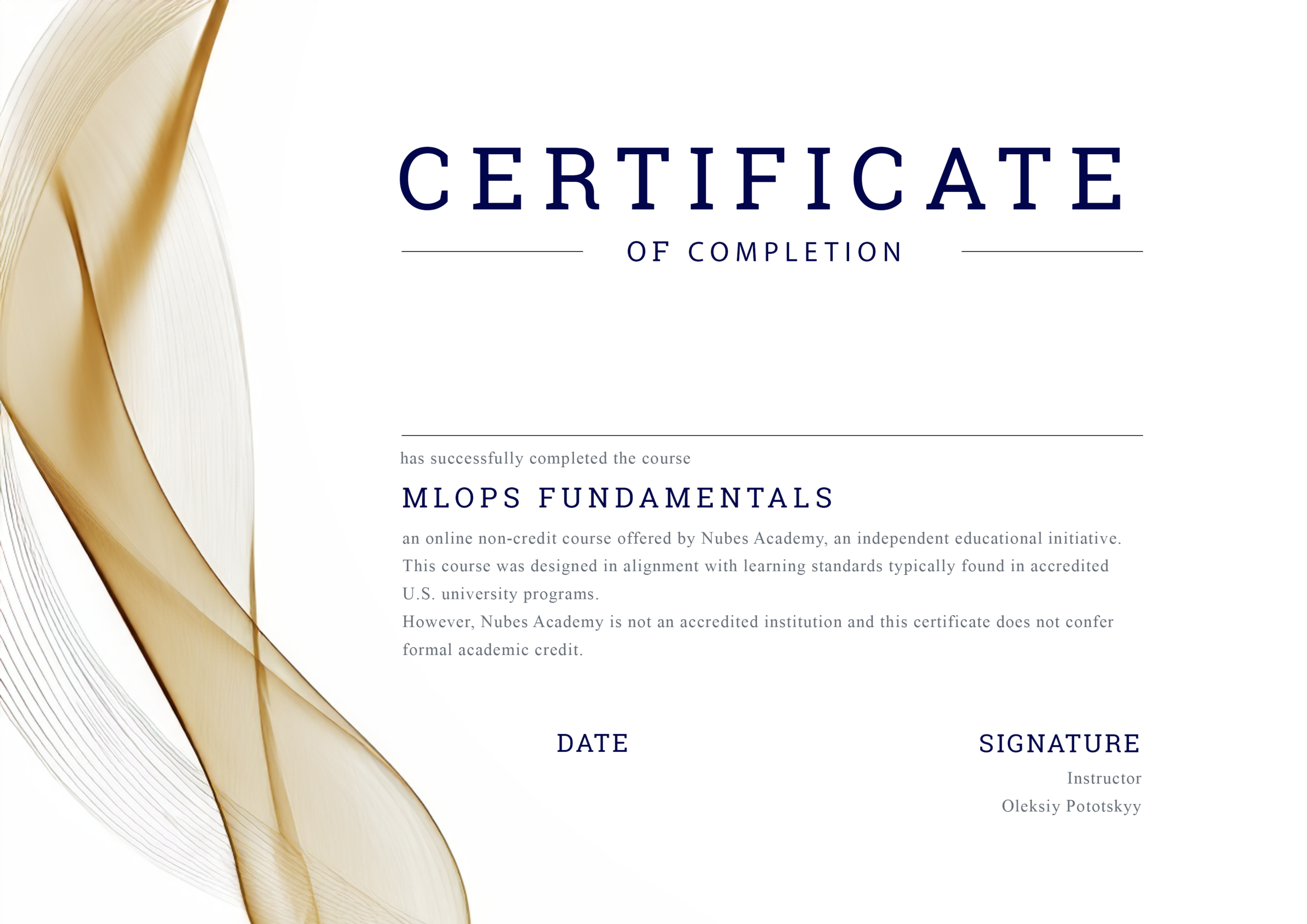
MLOps Fundamentals Certificate of Completion - Nubes Academy

Course credential

Certificate of Completion

Complete the course and earn a Certificate of Completion in Python for MLOps – shareable directly to your LinkedIn profile and CV. For engineers building a case for a role change or promotion, a verifiable credential in a high-demand technical skill carries real weight.

This certificate is also Step 2 of the MLOps Specialization path. Nubes Academy is developing university accreditation partnerships for the full specialization – meaning the credential you build today is designed to grow into something recognized beyond a standard online course certificate.

🎓 Part of the MLOps Specialization path Complete all courses in the specialization to qualify for the full Specialization Certificate – designed toward university accreditation.
Alex Pototskyy - Founder, Nubes Academy

Your instructor

About Your Instructor

Alex is an Independent Consultant with 20+ years of experience across Software development, DevOps, Architecture, and technical leadership. He developed and delivered Cloud & DevOps curriculum at Master’s Degree level at a university, and continues to work as an active practitioner alongside building Nubes Academy.

What makes Alex’s approach different: his courses are built from data, not assumptions. The MLOps Fundamentals curriculum was designed by analysing what MLOps engineers actually do in production, not by following a generic textbook outline. The result is a course that covers what your future employer expects, explained in a way that makes sense if you already think like an engineer.

If you have a background in IT, and you want to understand where ML fits into the systems you already work with – this course was built for exactly where you are.


Got questions?

Frequently asked questions

Basic software development concepts are enough — you don’t need prior Python experience. The course starts from Python fundamentals and builds up to MLOps-specific patterns. If you’ve worked with any scripting language (Bash, PowerShell, even basic YAML automation), you’ll find the pace comfortable.
It’s strongly recommended but not required. MLOps Fundamentals (Course #1) gives you the full-field overview that makes this course’s examples click into place — you’ll understand why each Python pattern matters for MLOps. If you already have solid MLOps context from work experience, you can start here directly.
The course includes 72 lectures and 4+ hours of video content, plus 15 quizzes — one per module. Most students complete it in 3–4 weeks studying a few hours per week at their own pace. You have 2 years of access, so you can also work through one module at a time alongside your daily job. Extension available if you need more time.
Entirely MLOps-specific. This is not a general Python tutorial. Every topic — from logging and serialization to NumPy and pytest patterns — is taught through MLOps use cases using real ML pipeline code. If you want to build web apps or learn Python for data science, this is the wrong course. If you want Python as an MLOps engineer, this is exactly right.
For MLOps. The NumPy and Pandas modules focus on how these libraries are used in MLOps pipelines — loading datasets, validating shapes and types, transforming data, exporting to files. You’ll learn how to process data as an operator, not how to build statistical models or visualizations for analysis.
Yes — you receive a Nubes Academy Certificate of Completion in Python for MLOps shareable on LinkedIn and your CV. This is also Step 2 of the MLOps Specialization. Nubes Academy is developing university accreditation partnerships — the full specialization certificate is designed to qualify as a recognized credential beyond a standard online course.
Yes. We offer team licenses for 5–20 engineers with a manager progress dashboard and kickoff session. Contact us at [email protected] for team pricing. For individual self-pay, see the pricing card above (excludes applicable VAT).
Yes — the introduction video is available free on this page and on the Nubes Academy YouTube channel. It gives you a clear sense of teaching style, depth, and pacing. If you have specific questions about fit, email us directly and we’ll help you decide.

Still have questions? Email us directly — we reply within 1-2 business day.

It’s not just skills. It’s your next chapter.

Stay ahead

New courses.
Better price.
Subscribers first.

  • Subscriber-only discount on every new course in the MLOps Specialization – before public launch price applies
  • Early access to new courses when they go live.
  • MLOps job market insights – what skills employers are actually hiring for, based on real job description data
  • Practical guides & free content – no noise, only what matters for engineers moving into MLOps

Get early access & subscriber discounts No spam. Unsubscribe any time.

Subscription Form

Your data is stored securely and never shared with third parties.  ·  Privacy Policy