Machine Learning Model Lifecycle
You can learn all steps of Model’s Lifecycle – from training up to prod
Building a model is just the beginning. The real challenge is keeping it stable, accurate, and useful over time – through version changes, data drift, infrastructure updates, and shifting business requirements. This course teaches you the complete ML model lifecycle: from experiment tracking to production monitoring, drift handling, and safe retraining.
- Manage models through the full lifecycle – dev → staging → production – with control and reproducibility
- Track experiments, package models, and promote them through registry stages using MLflow
- Deploy models safely using shadow traffic, canary releases, and blue/green patterns
- Monitor for drift, trigger retraining, and execute rollbacks from structured runbooks
- Apply the same lifecycle framework to both classical ML and LLM/GenAI systems
Sound familiar?
Your model is in production. Now what?
Most MLOps engineers learn how to get a model into production. Almost none are taught what to do once it’s there – how to monitor it, when to retrain it, how to replace it safely, and what to do when it starts failing. The lifecycle doesn’t end at deployment. It starts there.
What makes this different
Not model training.
Everything that comes after.
Most ML courses end when the model is trained. This course starts where those courses end – at the point where production systems, business requirements, and changing data make the real work begin.
A single running project, end to end
The Customer Churn Prediction model runs through every module – tracked in MLflow, packaged and promoted through the registry, deployed with canary releases, monitored for drift, and retrained with automated promotion. You see the lifecycle as a connected system, not isolated topics.
Covers what engineers actually face in production
Feature store skew, champion-challenger evaluation, rollback criteria at the model layer, runbooks for on-call MLOps engineers, SLOs and alert thresholds – these appear in every senior MLOps role. This course teaches them explicitly, not as footnotes.
MLflow used throughout – with real registry workflows
Experiment tracking, model packaging, registry stages, and automated promotion are all built with MLflow across the lab exercises. You finish the course knowing how to configure and use a real model registry, not just what one is.
Deployment safety — shadow, canary, blue/green
Shadow traffic and canary releases are explained specifically for ML models – how rollback criteria differ from standard web services, how to define them at the model layer, and how to run a shadow → canary flow in staging before any user is affected.
Drift detection with automated retraining
The monitoring module goes beyond dashboards – you implement a drift-triggered retrain with automated registry promotion. This is the pattern production ML teams run but almost no course teaches explicitly.
Explicitly covers LLMs alongside classical ML
The final content module compares lifecycle artifacts and workflows for a classical churn model versus an LLM-based classifier – covering what changes (prompt versioning, evaluation, cost profile, guardrails) and what stays the same. MLOps in 2025 means both.
❌ ML courses that stop at training
✓ ML Model Lifecycle
Learning outcomes
By the end of this course, you’ll be able to:
Six production-ready skills that give you end-to-end control over ML models – from the first experiment to the last rollback.
What you’ll learn
Course Curriculum
Introduction
+
- Course Introduction
- About Your Instructor
- Course Structure
- Customer Churn Prediction Project — the running example
- What This Course Covers, and What It Does Not
- Course Materials
The ML Model Lifecycle
+
- What is the ML Model Lifecycle
- Key Roles and Handoffs
- Core Artifacts — Code, Data Refs, Metrics, Model, Docs
- Environments: Dev → Staging → Production
- RACI and Change Control for ML Models
Experiment Tracking & Reproducibility
+
- Why Reproducibility is a Production Requirement
- What to Track — Params, Metrics, Artifacts, Environment, Tags
- Baselines and Acceptance Criteria
- Reproducible Environments — Dependency Pinning and Seeds
- Track Two Churn Model Variants and Compare — Hands-on Lab (MLflow)
Evaluation & Validation Gates
+
- Metric Taxonomy — Classification, AUC/PR, Cost-Aware Metrics
- Holdouts and Cross-Validation
- Fairness and Bias Checks as Validation Gates
- Champion vs. Challenger — Promotion Criteria
- Build an Evaluation Report with Fairness Checks — Hands-on Lab
Model Packaging & Registry
+
- What Model Packaging Means and Why Format Matters
- Input/Output Schemas and the Model Contract
- Dependency Pinning and Runtime Specs
- The Registry as System of Record — Stages, Metadata, Audit Trail
- Model Cards and Release Notes
- Package, Document, and Promote the Churn Model Through Registry Stages — Hands-on Lab (MLflow)
Feature Stores: Core Concepts
+
- The Training-Serving Skew Problem
- Offline Store, Online Store, and the Consistency Guarantee
- Point-in-Time Correctness — Avoiding Data Leakage at Retrain Time
- Where Feature Stores Fit in the Lifecycle
- Define a Feature Spec and Simulate a Point-in-Time Pull for the Churn Model — Hands-on Lab
Serving Patterns
+
- Batch vs. Online vs. Streaming — How to Choose
- Online Serving — Request Contract, Health Probes, Timeouts
- Batch Serving — Scheduling, Output Storage, Failure Points
- The Serving Stack Landscape — FastAPI, BentoML, KServe
- Deploy an Online Endpoint for the Churn Model — Hands-on Lab
Pre-Production Deployment
+
- Shadow Traffic — Validate Without User Impact
- Canary Releases — Incremental Rollout and Rollback Rules
- Blue/Green — Safe Cutover and Quick Revert
- Defining Rollback Criteria at the Model Layer
- Run a Shadow → Canary Flow in Staging — Hands-on Lab
Monitoring, Feedback & Retraining
+
- What to Log — Predictions, Features, Ground Truth
- Drift Types — Data Drift, Concept Drift, Prediction Drift
- Retraining Triggers — Drift, Time-Based, Quality Drop
- Full vs. Incremental Retraining
- Safe Promotion After Retrain
- Implement a Drift-Triggered Retrain with Automated Registry Promotion — Hands-on Lab
Failure Modes & Runbooks
+
- Common Incidents — Schema Mismatch, Data Change, Drift Spike, Cost Blow-Up
- First Response — Freeze, Rollback, or Degrade Gracefully
- Minimal Runbook Template for On-Call MLOps Engineers
- SLOs and Alert Thresholds at the Model Layer
- Simulate a Bad Release and Execute Rollback Using a Runbook — Hands-on Lab
Classical ML vs. LLMs & GenAI
+
- What Stays the Same Across the Lifecycle
- What Changes — Prompt Versioning, Evaluation, Cost Profile, Guardrails
- Why Standard Metrics Are Insufficient for LLMs
- Pointer to LLMs & GenAI for MLOps course
- Compare Lifecycle Artifact Checklists — Churn Model vs. LLM-Based Classifier — Hands-on Lab
Is this course right for you?
Built for engineers who manage ML models in production, or will soon
You don’t need to be a model builder. You need to understand how models move through production, how to keep them healthy over time, and what to do when they break.
Prerequisites — what you need before starting:
✓ You need
✗ You do NOT need
MLOps Specialization path
This is Course #1 of the full
MLOps Specialization
Each course builds on the previous one. Start here to get your field overview – then go as deep as your career requires.
Start with MLOps Fundamentals and decide your next step based on your career goals.
Start with Course #1 – Enroll NowComing soon
Be first when Machine Learning Model Lifecycle launches
Join the waitlist to secure subscriber pricing and get notified the moment the course goes live. Everything planned for the course, confirmed from the curriculum draft:
-
10 content modules – full lifecycle, end to end From experiment tracking through to rollback runbooks and LLM lifecycle comparison.
-
9 hands-on labs — MLflow + Customer Churn Prediction One lab per content module, building on the same running project throughout the course.
-
Capstone project with instructor review Apply the complete lifecycle framework to a real scenario, reviewed by Alex personally.
-
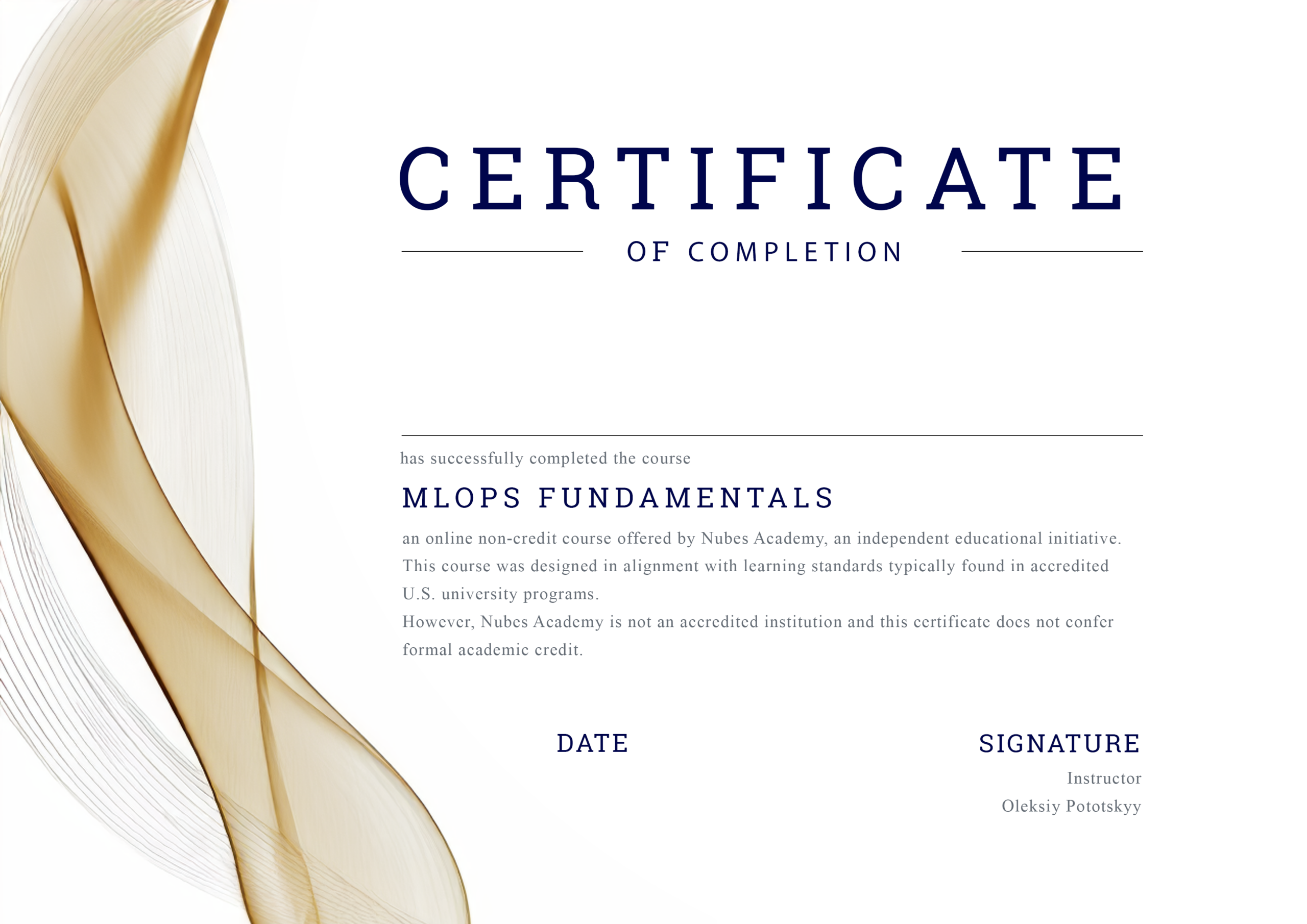
Certificate of Completion Shareable on LinkedIn and CV. Step 4 of the MLOps Specialization credential path.
- ✓ 10 content modules confirmed
- ✓ 9 hands-on labs (MLflow)
- ✓ Capstone + instructor review
- ✓ Certificate of Completion
- ✓ Customer Churn running project
Course credential
Certificate of Completion
Complete the course and earn a Certificate of Completion in Machine Learning Model Lifecycle — shareable directly to your LinkedIn profile and CV. For engineers building a case for a senior MLOps role, demonstrating structured lifecycle management knowledge is a credible differentiator from engineers who only manage infrastructure.
This certificate is also Step 4 of the MLOps Specialization path. Nubes Academy is developing university accreditation partnerships for the full specialization — the credential you build today is designed to grow into something recognized beyond a standard online course certificate.

Your instructor
About Your Instructor
Alex is an Independent Consultant with 20+ years of experience across Software development, DevOps, Architecture, and technical leadership. He developed and delivered Cloud & DevOps curriculum at Master’s Degree level at a university, and continues to work as an active practitioner alongside building Nubes Academy.
What makes Alex’s approach different: his courses are built from data, not assumptions. The MLOps Fundamentals curriculum was designed by analysing what MLOps engineers actually do in production, not by following a generic textbook outline. The result is a course that covers what your future employer expects, explained in a way that makes sense if you already think like an engineer.
If you have a background in IT, and you want to understand where ML fits into the systems you already work with – this course was built for exactly where you are.
Got questions?
Frequently asked questions
Still have questions? Email us directly — we reply within 1–2 business days.
It’s not just skills. It’s your next chapter.
Stay ahead
New courses.
Better price.
Subscribers first.
- Subscriber-only discount on every new course in the MLOps Specialization – before public launch price applies
- Early access to new courses when they go live.
- MLOps job market insights – what skills employers are actually hiring for, based on real job description data
- Practical guides & free content – no noise, only what matters for engineers moving into MLOps
Get early access & subscriber discounts No spam. Unsubscribe any time.
Your data is stored securely and never shared with third parties. · Privacy Policy