Data for MLOps
You can learn why data is core part of Machine Learning Operations
ML models don’t fail because of bad code. They fail because of bad data — data that drifted, data that was split incorrectly, features that compute differently at training time and serving time. This course teaches you how to treat data with the same engineering discipline you apply to code: versioned, validated, monitored, and ready for production at every stage of the ML lifecycle.
- Build reliable data ingestion pipelines from batch, streaming, and API sources
- Version datasets and link data versions to model versions — so every model is reproducible
- Engineer features correctly and serve them consistently — eliminating training-serving skew
- Implement data validation gates that catch schema and statistical issues before they reach training
- Prepare data for all model types — tabular, text, image, and LLM/GenAI workloads
Sound familiar?
Your model was working fine. Then the data changed. Nobody noticed until the business did.
Most MLOps engineers learn how to get a model into production. Almost none are taught what to do once it’s there – how to monitor it, when to retrain it, how to replace it safely, and what to do when it starts failing. The lifecycle doesn’t end at deployment. It starts there.
In most ML teams, data is treated as a precondition — something the data science team handles before the pipeline starts. MLOps engineers are left to manage models without clear ownership of the data flowing through them. The result: silent failures, unexplained regressions, and production incidents that trace back to a data problem nobody was watching.
What makes this different
Not a data engineering course.
Not a data science course.
Data management from the MLOps perspective.
Data engineering courses teach you to build data pipelines. Data science courses teach you to analyse data. This course teaches you to manage data the way MLOps engineers do — with versioning, validation gates, feature store consistency, and drift alerts built into the ML workflow.
Covers the full data lifecycle for ML
From the first ingestion pipeline through validation, feature engineering, feature stores, dataset versioning, label management, and drift monitoring — the entire journey of data through an ML system, in the order that MLOps engineers encounter it.
Feature stores taught as production infrastructure
Most courses explain what a feature store is. This course teaches you to build and use one — registering features, retrieving them correctly for both offline training and online serving, and avoiding the training-serving skew that makes otherwise good models fail silently.
Data versioning linked to model versioning
The dataset versioning module doesn’t stop at “how to version a dataset” — it teaches you to link data versions to model versions in the registry, so every model you’ve ever trained is fully reproducible from both the code and the data it saw.
10 focused hands-on labs — one per module
Each content module ends with a lab that applies the module’s concepts to a concrete task: build an ingestion pipeline, organize partitioned storage, version a dataset, build a feature store, implement validation checks. The labs span different data types, giving you breadth across tabular, text, image, and LLM data.
LLM and GenAI data as a first-class module
Prompt/response data collection, cleaning, and filtering for LLM training data is a dedicated module — not a footnote. You’ll build a dataset of prompt-response pairs with the quality controls that responsible LLM fine-tuning requires.
Labels, ground truth, and golden datasets
Label management is covered explicitly — label drift, labelling errors, and golden datasets for quality control. These are the data quality problems that cause model performance to degrade after launch, and they’re almost never covered in standard ML courses.
❌ Data engineering / data science courses
✓ Data for MLOps
Learning outcomes
By the end of this course, you’ll be able to:
Six data management skills that give you full control over the data flowing through your ML systems – from the first byte ingested to the drift alert that triggers retraining.
What you’ll learn
Course Curriculum
Introduction
+
- Course Introduction
- About Your Instructor
- Course Structure
- What is Data in Machine Learning
- Machine Learning Data Lifecycle
- Roles and Responsibilities in Data Preparation
- GitHub Repositories
Data Collection & Ingestion
+
- Sources of ML Data — Batch, Streaming, APIs
- Common Ingestion Patterns for ML
- Ensuring Reliability in Data Ingestion
- Build a Simple Ingestion Pipeline (Batch or Stream) — Hands-on Lab
- Quiz — Data Collection & Ingestion
Data Storage
+
- Data Lakes, Warehouses, and Lakehouses for ML
- File Formats for ML — CSV, Parquet, Avro, ORC
- Partitioning and Layout for ML Data
- Organize ML Dataset Storage with Partitions — Hands-on Lab
- Quiz — Data Storage
Data Preparation Basics
+
- Cleaning and Normalizing ML Data
- Handling Missing and Imbalanced Data
- Splitting Data for Training, Validation, and Testing
- Prepare a Tabular Dataset for Model Training — Hands-on Lab
- Quiz — Data Preparation Basics
Dataset Versioning
+
- Why Versioning is Critical in MLOps
- Tools and Patterns for Data Versioning
- Linking Data Versions with Model Versions
- Version a Dataset and Connect It to a Model Registry — Hands-on Lab
- Quiz — Dataset Versioning
Feature Engineering
+
- What is Feature Engineering
- Feature Transformation in Batch vs. Serving
- Avoiding Training–Serving Skew
- Create a Reproducible Feature Transformation Pipeline — Hands-on Lab
- Quiz — Feature Engineering
Feature Stores
+
- What is a Feature Store
- Offline vs. Online Feature Stores
- Registering and Retrieving Features for ML Models
- Build and Use a Simple Feature Store — Hands-on Lab
- Quiz — Feature Stores
Data Validation & Quality Checks
+
- Common Data Quality Issues in ML Pipelines
- Schema Validation for ML Data
- Statistical Validation for ML Data
- Implement Data Validation Checks in a Pipeline — Hands-on Lab
Labels & Ground Truth
+
- What is Label Data
- Managing Label Drift and Errors
- Golden Datasets for Quality Control
- Create a Labeled Dataset with Quality Checks — Hands-on Lab
- Quiz — Labels & Ground Truth
Data for Different ML Models
+
- Preparing Tabular Data for ML
- Preparing Text Data for ML
- Preparing Image Data for ML
- Prepare a Dataset of Your Choice for Model Training — Hands-on Lab
- Quiz — Data for Different ML Models
Data for LLMs & GenAI
+
- Special Considerations for LLM Training Data
- Prompt/Response Data Collection
- Cleaning and Filtering for LLM Data
- Build a Dataset of Prompt–Response Pairs — Hands-on Lab
- Quiz — Data for LLMs & GenAI
Is this course right for you?
Built for engineers who own ML systems — not just the models inside them
You don’t need to be a data scientist. You need to understand how data flows through ML systems, how it can go wrong silently, and how to build the management layer that keeps it reliable in production.
Prerequisites — what you need before starting:
✓ You need
✗ You do NOT need
MLOps Specialization path
This is Course #1 of the full
MLOps Specialization
Each course builds on the previous one. Start here to get your field overview – then go as deep as your career requires.
Start with MLOps Fundamentals and decide your next step based on your career goals.
Start with Course #1 – Enroll NowComing soon
Be first when Data for MLOps launches
Join the waitlist to secure subscriber pricing and get notified the moment the course goes live. Everything planned, confirmed from the curriculum draft:
-
10 content modules — full data management stack From ingestion and storage through validation, versioning, feature stores, labels, and LLM data preparation.
-
10 hands-on labs — one focused dataset task per module Build an ingestion pipeline, organize partitioned storage, create a feature store, implement validation checks, and more.
-
10 quizzes + Final Quiz Reinforce understanding at the end of each content module.
-
Certificate of Completion Step 6 of the MLOps Specialization credential path.
- ✓ 10 content modules confirmed
- ✓ 10 hands-on labs
- ✓ 10 quizzes + final quiz
- ✓ Capstone + instructor review
- ✓ Certificate of Completion
Course credential
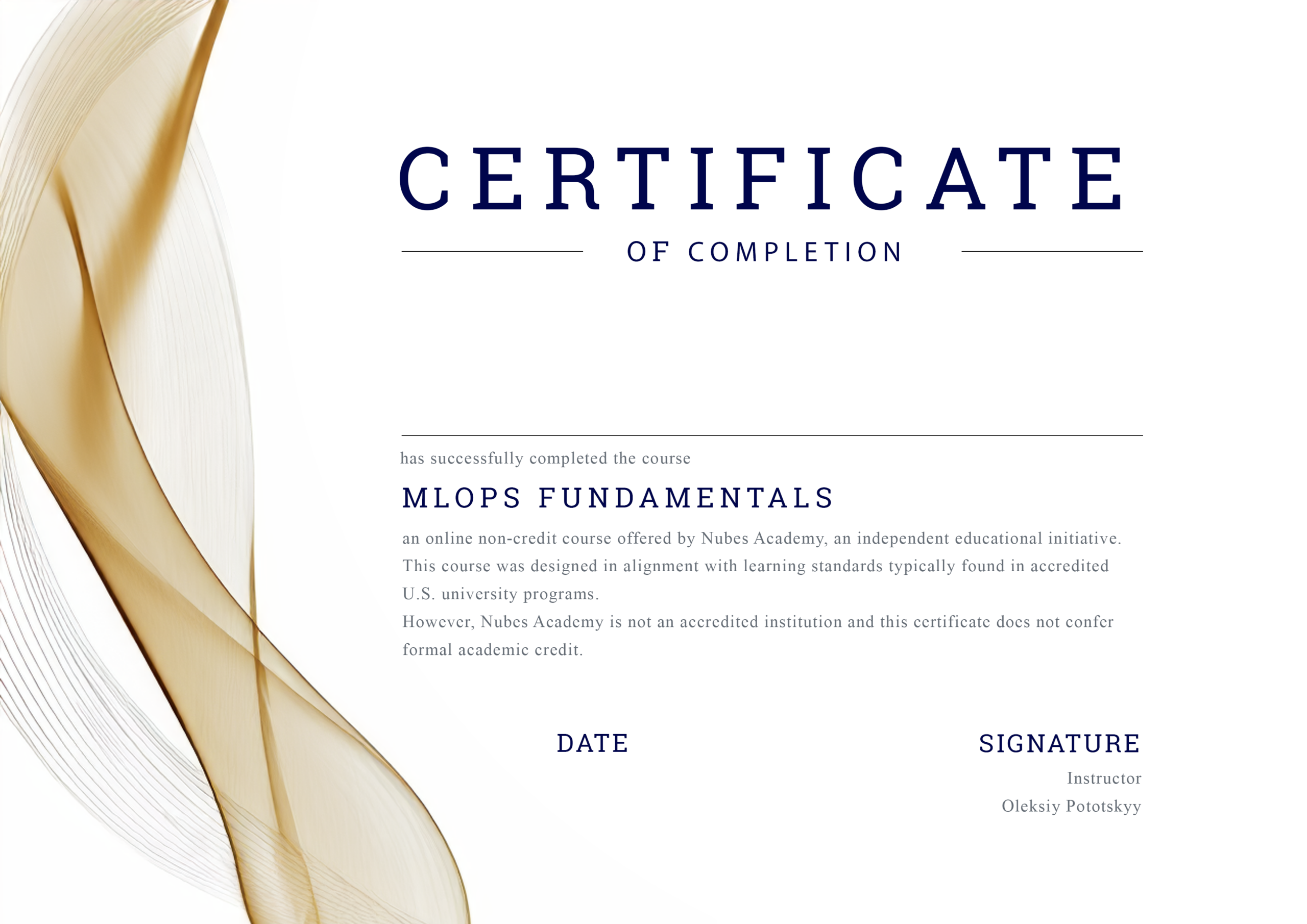
Certificate of Completion
Complete the course and earn a Certificate of Completion in Data for MLOps — shareable directly to your LinkedIn profile and CV. Data quality, versioning, and feature management are consistently cited as critical gaps in ML engineering roles at senior level, and a verifiable credential in this domain is a meaningful differentiator.
This certificate is Step 6 of the MLOps Specialization. Nubes Academy is developing university accreditation partnerships for the full specialization — the credentials you build today are designed to grow into something recognized beyond a standard online course certificate.

Your instructor
About Your Instructor
Alex is an Independent Consultant with 20+ years of experience across Software development, DevOps, Architecture, and technical leadership. He developed and delivered Cloud & DevOps curriculum at Master’s Degree level at a university, and continues to work as an active practitioner alongside building Nubes Academy.
What makes Alex’s approach different: his courses are built from data, not assumptions. The MLOps Fundamentals curriculum was designed by analysing what MLOps engineers actually do in production, not by following a generic textbook outline. The result is a course that covers what your future employer expects, explained in a way that makes sense if you already think like an engineer.
If you have a background in IT, and you want to understand where ML fits into the systems you already work with – this course was built for exactly where you are.
Got questions?
Frequently asked questions
Still have questions? Email us directly — we reply within 1–2 business days.
It’s not just skills. It’s your next chapter.
Stay ahead
New courses.
Better price.
Subscribers first.
- Subscriber-only discount on every new course in the MLOps Specialization – before public launch price applies
- Early access to new courses when they go live.
- MLOps job market insights – what skills employers are actually hiring for, based on real job description data
- Practical guides & free content – no noise, only what matters for engineers moving into MLOps
Get early access & subscriber discounts No spam. Unsubscribe any time.
Your data is stored securely and never shared with third parties. · Privacy Policy