CI/CD for MLOps
You can learn how CI/CD helps Machine Learning projects
Most ML models fail in production not because the model is bad — but because there’s no reliable process behind it. Every deployment is manual. Every retrain is ad hoc. Every rollback is a scramble. CI/CD for MLOps gives you the process that makes ML production-ready: automated pipelines for data, training, packaging, and deployment, with safety gates at every stage.
- Build CI/CD pipelines purpose-built for ML — covering data contracts, training smoke tests, and model packaging in a single automated flow
- Implement safe rollout patterns — shadow traffic, canary releases, and blue/green — at the model layer, not just infrastructure
- Set up promotion gates that enforce metric thresholds, eval reports, and approver checks before any model reaches production
- Apply supply chain security basics, observability hooks, and cost guards without leaving CI/CD
- Leave the course with a golden pipeline template ready to apply to your own ML projects
Sound familiar?
Your ML deployments work — until they don’t. And when they don’t, nobody knows why.
ML teams that lack CI/CD don’t just deploy slowly — they deploy dangerously. Manual steps, no automated tests, no promotion gates, no rollback procedure. When a bad model reaches production, the best-case outcome is a scrambled hotfix. The worst case is business impact that takes days to trace back to a model that slipped through unverified.
What makes this different
Not a DevOps CI/CD course with ML bolted on.
ML CI/CD designed from first principles.
Standard CI/CD courses treat model deployment like any other artifact deployment. This course is built around the problems that are unique to ML — data quality, training reproducibility, model evaluation, drift-triggered retraining — and builds a complete automation stack around them.
Three distinct CI types — Data CI, Training CI, Packaging CI
Most CI/CD courses cover code CI. ML needs three more: Data CI for schema and quality checks on every change, Training CI for reproducible smoke runs and eval reports, and Model Packaging CI for container builds, image scanning, and format validation. Each is a separate module with its own patterns.
One project, end to end: Customer Churn Prediction Service
The Customer Churn Prediction Service — an API + batch pipeline — runs through every module. You see how Data CI feeds Training CI, how Training CI gates Model Packaging, how the registry gates deployment, and how the deployment pipeline feeds into monitoring. The pipeline is one connected system, not isolated exercises.
Safe rollout patterns applied specifically to ML models
Shadow traffic, canary releases, and blue/green aren’t new to DevOps — but their application to ML models has specific wrinkles. Rollback criteria at the model layer, auto-rollback on SLO breach, shadow comparison of model outputs: these are covered as ML-specific patterns, not generic DevOps theory.
Golden pipeline template you take away from the course
The Reuse & Templates module and the Capstone produce a reusable pipeline template — the golden pipeline that covers train → package → register → deploy for any new ML model. You leave the course with a working artifact, not just knowledge.
Covers LLM CI/CD patterns alongside classical ML
The LLM Inference case study applies the CI/CD framework to a generative AI workload — image build for large model containers, cold-start testing, and canary releases using quality probes instead of traditional metrics. ML CI/CD in 2025 means handling both.
Security, observability, and cost — without separate courses
Supply chain security basics (SBOM, image signing, least-privilege tokens), observability hooks (pipeline metrics, SLO linkage), and cost-aware CI/CD (cache strategy, right-sizing runners, fail-fast thresholds) are all included as modules — with explicit handoffs to the dedicated specialization courses for deeper coverage.
❌ Generic DevOps CI/CD courses
✓ CI/CD for MLOps
Learning outcomes
By the end of this course, you’ll be able to:
Six CI/CD capabilities that give your ML team a reliable, automated path from code change to production — for classical ML and LLM workloads.
What you’ll learn
Course Curriculum
Introduction
+
- Course Introduction
- About Your Instructor
- Course Structure
- Customer Churn Prediction Service — API + Batch Pipeline Project
- Monorepo vs. Multi-repo for MLOps — Code, Data, and Infra Folders
- GitHub Repositories
CI Basics for ML Projects
+
- Branching Model and Naming — Feature / Bugfix / Release
- Pre-commit Hooks — Format, Lint, Security Checks
- Fast PR Checks — Unit Tests, Style, Type Hints
- Caching in CI — pip Cache, Docker Layer Cache
Data CI — Contracts & Quality on Every Change
+
- Data Contracts and Schemas — What Must Not Change
- Sample-Based Checks — Freshness, Nulls, Ranges, Categories
- Contract Tests for Features — Breaking vs. Non-Breaking Changes
- Generating Quick Data Reports as PR Artifacts
Training CI — Fast, Deterministic, Reviewable
+
- Smoke Training on a Small Slice with Fixed Seed
- Reproducibility Check — Same Code/Data → Same Metrics
- Offline Eval Report — AUC/PR, Calibration — as Pipeline Artifact
- Time and Cost Limits for CI Training Jobs
Model Packaging CI
+
- Model Signatures — I/O Schema and Validation
- Packaging Options — pyfunc / ONNX / TorchScript
- Container Build — Multi-Stage, Slim Runtime
- Image Scan and Size Budgets
Model Registry & Promotion Gates
+
- Register Model with Links to Code, Data, and Metrics
- Stages — Dev → Staging → Production
- Promotion Gates — Metric Deltas, Eval Report, Approver Check
- Model Card and Release Notes Generated from CI Data
Deployment Pipelines
+
- Batch Scoring Deploy — Job/CronJob Template + Schedule
- Online Serving Deploy — KServe / Seldon / BentoML or FastAPI + Ingress
- Health Checks — Readiness/Liveness Probes and Timeouts
- Secrets and Configs — Env Vars, ConfigMap/Secret Basics
Safe Rollouts — Shadow, Canary, Blue/Green
+
- Shadow Traffic — Compare Outputs Without User Impact
- Canary Releases — %-Traffic Split, Auto-Rollback on SLO Breach
- Blue/Green Switch and Fast Revert Path
- Load Test Step in Pipeline — K6 / Locust Job
Test Strategy & Quality Gates for ML CI/CD
+
- Code Tests — Unit, Integration, Contract Tests
- Data Tests — Schema, Drift Pre-Checks, Sample Integrity
- Model Tests — Performance Smoke, Fairness Spot-Check
- Non-Functional Checks — Latency, Memory, Cold-Start
Environments & Configuration
+
- Dev / Staging / Prod Flows — One Pipeline, Different Params
- Versioning and Semantic Releases — Tags, Changelogs
- Feature Flags and Config-as-Data for Experiments
- Secrets Rotation and Minimal Access
Runners, Compute & Artifacts
+
- Hosted vs. Self-Hosted Runners — When You Need GPU Runners
- Artifact Stores and Retention — Logs, Models, Reports
- Parallel Jobs and Matrices — Python Versions, OS
- Queue Limits, Concurrency, and Cancellation Policies
Observability Hooks for Pipelines
+
- Emit Pipeline Metrics — Durations, Pass/Fail, Queue Time
- Store Logs and Artifacts for Audits and Root Cause Analysis
- Link Deploy Step to Service SLOs — Error Rate, Latency
- Hand-off to MLOps Observability course for deep dashboards (Course #7)
Supply Chain Security
+
- SBOM Generation and Dependency Scanning
- Sign Images and Verify on Deploy
- Least-Privilege Tokens for CI/CD
- Hand-off to MLOps Security & Compliance course for audits (Course #8)
Reuse & Templates
+
- Reusable Workflows and Shared CI Libraries
- Pipeline Composition — Train → Package → Register → Deploy
- Parameterized Jobs per Repo — API, Batch, Feature Generation
- Golden Pipeline Template for New Models
Cost-Aware CI/CD
+
- Cache Strategy and Job Timeouts
- Right-Size Runners and Schedules
- Fail-Fast on Thresholds — Avoid Noisy Retriggers
- Hand-off to FinOps course for full cost guardrails
Case Studies
+
- Churn Service — End-to-End PR → Canary → Promote
- Time Series Forecasting — Scheduled Retrain + Batch Deploy
- LLM Inference — Image Build, Cold-Start Test, Canary on Quality Probes
Is this course right for you?
Built for engineers who want to stop deploying ML models by hand
You don’t need to be a data scientist. You need to understand CI/CD — and you need to know how to extend it to handle the parts that are unique to ML systems: data, training, evaluation, and model-layer rollback.
Prerequisites — what you need before starting:
✓ You need
✗ You do NOT need
MLOps Specialization path
This is Course #1 of the full
MLOps Specialization
Each course builds on the previous one. Start here to get your field overview – then go as deep as your career requires.
Start with MLOps Fundamentals and decide your next step based on your career goals.
Start with Course #1 – Enroll NowComing soon
Be first when CI/CD for MLOps launches
Join the waitlist to secure subscriber pricing and get notified the moment the course goes live. Everything planned, confirmed from the curriculum draft:
-
15 content modules — complete CI/CD pipeline stack From branching models and data contracts through to cost-aware pipelines and reusable templates.
-
3 case studies — Churn, Time Series, LLM Inference End-to-end scenarios applying the pipeline to different ML deployment types including a generative AI workload.
-
Capstone project — golden pipeline template Apply the full pipeline to your own ML project and leave with a reusable template ready for production.
-
Certificate of Completion Step 5 of the MLOps Specialization credential path.
- ✓ 15 content modules confirmed
- ✓ 3 case studies (incl. LLM CI/CD)
- ✓ Capstone + golden pipeline template
- ✓ Certificate of Completion
- ✓ Customer Churn running project
Course credential
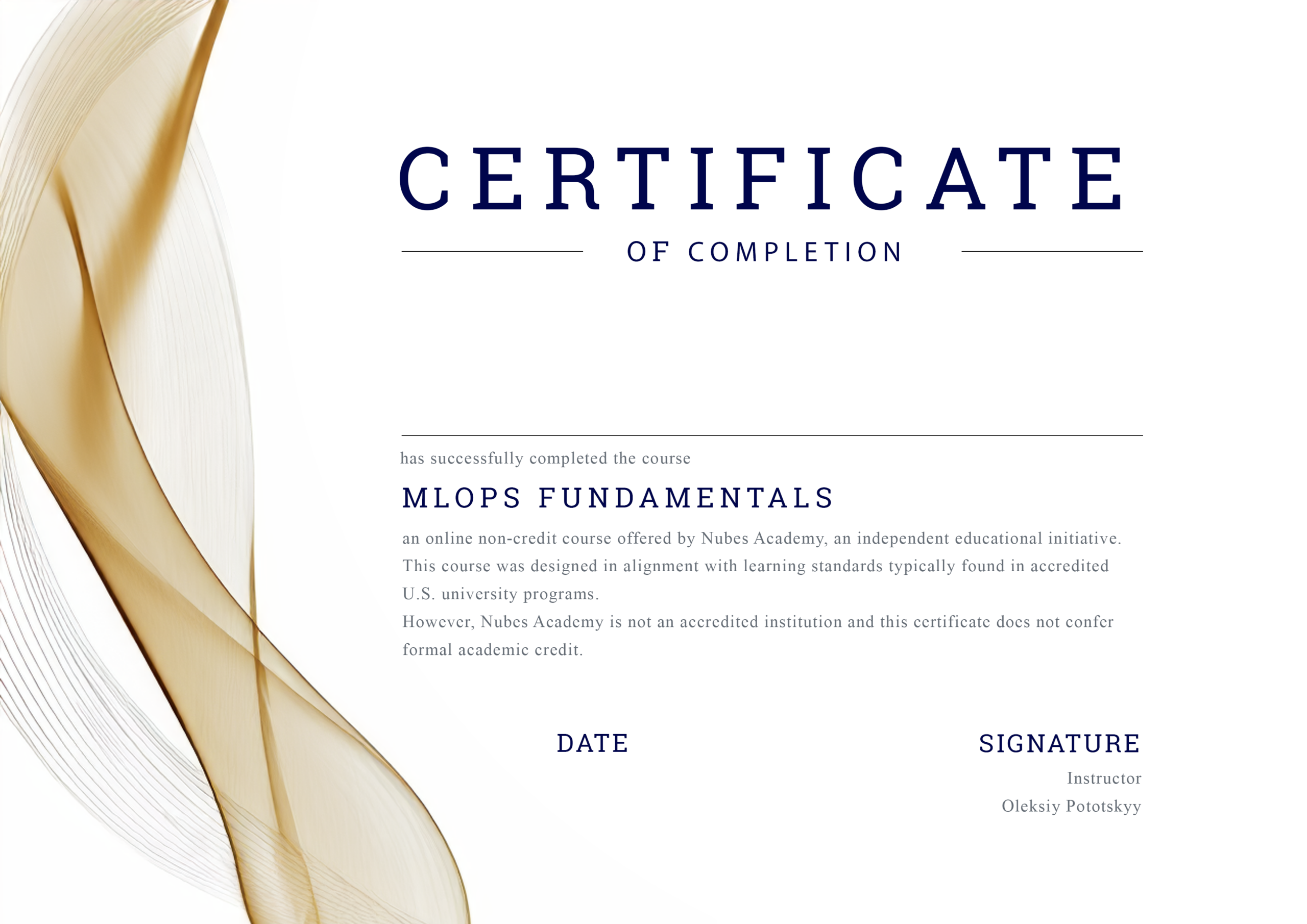
Certificate of Completion
Complete the course and earn a Certificate of Completion in CI/CD for MLOps — shareable directly to your LinkedIn profile and CV. CI/CD automation for ML is one of the most in-demand skills in MLOps job descriptions, and a verifiable credential in this domain carries real weight in technical hiring.
This certificate is Step 5 of the MLOps Specialization. Nubes Academy is developing university accreditation partnerships for the full specialization — the credentials you build today are designed to grow into something recognized beyond a standard online course certificate.

Your instructor
About Your Instructor
Alex is an Independent Consultant with 20+ years of experience across Software development, DevOps, Architecture, and technical leadership. He developed and delivered Cloud & DevOps curriculum at Master’s Degree level at a university, and continues to work as an active practitioner alongside building Nubes Academy.
What makes Alex’s approach different: his courses are built from data, not assumptions. The MLOps Fundamentals curriculum was designed by analysing what MLOps engineers actually do in production, not by following a generic textbook outline. The result is a course that covers what your future employer expects, explained in a way that makes sense if you already think like an engineer.
If you have a background in IT, and you want to understand where ML fits into the systems you already work with – this course was built for exactly where you are.
Got questions?
Frequently asked questions
Still have questions? Email us directly — we reply within 1–2 business days.
It’s not just skills. It’s your next chapter.
Stay ahead
New courses.
Better price.
Subscribers first.
- Subscriber-only discount on every new course in the MLOps Specialization – before public launch price applies
- Early access to new courses when they go live.
- MLOps job market insights – what skills employers are actually hiring for, based on real job description data
- Practical guides & free content – no noise, only what matters for engineers moving into MLOps
Get early access & subscriber discounts No spam. Unsubscribe any time.
Your data is stored securely and never shared with third parties. · Privacy Policy