Security & Compliance for MLOps
You can learn why security & compliance are important for MLOps
A model in production is a legal entity, a data processor, and a security attack surface. It works with real users’ private data, makes decisions that may be regulated, and can be exploited in ways a web service cannot. This course teaches you how to protect ML systems after they go live — securing the infrastructure, protecting the data, satisfying the auditors, and handling the incidents.
- Lock down access to models, features, and pipelines — service accounts, scoped tokens, secrets management, and network rules
- Protect training data and model artifacts from poisoning, leakage, and integrity failures
- Apply EU AI Act, GDPR, NIST AI RMF, and ISO frameworks to real ML systems — with audit evidence ready
- Add LLM-specific guardrails — prompt injection defences, content filters, RAG access controls
- Respond to ML security incidents with structured runbooks, triage procedures, and post-mortem evidence packs
Sound familiar?
Your model is in production. Your legal and security teams are asking questions you can’t answer.
Deploying a model is the point where technical responsibility meets legal accountability. Data protection laws, AI regulation, access control audits, and security incidents don’t announce themselves in advance. Most MLOps engineers reach production without ever having built the controls, documentation, or runbooks that regulators, auditors, and security teams need to see.
What makes this different
Not a general security course with ML examples.
Not a compliance course that skips the engineering.
Both, built specifically for MLOps.
Security and compliance courses for software engineers don’t cover ML-specific risks. ML courses skip security and compliance. This course covers both — the hands-on security controls and the compliance evidence — in the context of the specific threats and regulations that affect ML systems in production.
14 hands-on labs — applied directly to the running project
Every security control is implemented, not just described. Lock down the Churn API. Add SBOM and image signing to the build. Build a PII filter. Detect a poisoning attempt and fail the build. Add guardrails to the LLM endpoint. Simulate an incident. By the end you’ve applied the full security and compliance stack to a real system.
Compliance frameworks mapped to actual pipeline controls
Most compliance training explains what GDPR and the EU AI Act require. This course maps those requirements to specific pipeline gates, CI checks, model cards, and approval workflows — so you know exactly which engineering artifact satisfies which compliance requirement when the auditor asks.
LLM and RAG security as a dedicated module
Prompt injection, jailbreaks, PII leakage through generated outputs, and RAG access control are covered in full — not as a footnote. The lab adds a guardrail chain to the LLM/RAG helpdesk endpoint covering allow/deny lists, content filters, PII stripping from retrieved documents, and index access control.
Produces audit-ready evidence from the pipeline itself
Model cards generated from CI artifacts. Release notes tied to eval reports. System fact sheets completed for the running project. Three pipeline gates (PII scan, eval threshold, approver) added as code. The course teaches you to generate evidence as a side effect of good engineering — not as a separate manual process.
Fairness and explainability as release gates, not afterthoughts
The Bias, Fairness & Explainability module covers per-group metric checks and basic explainers specifically in the context of release decisions — when to block a release, when to log and track, and where in the ML pipeline these checks belong. This is the fairness engineering perspective, not the fairness research perspective.
A secure-by-default template as the course take-home artifact
The Summary module and Capstone produce a secure-by-default template for new model repositories — covering least-privilege defaults, deny-by-default settings, checklists for new model onboarding, and a Security & Compliance backlog starter. You leave the course with a reusable artifact, not just knowledge.
❌ Generic security / compliance courses
✓ Security & Compliance for MLOps
Learning outcomes
By the end of this course, you’ll be able to:
Six security and compliance capabilities that make your ML systems safe, auditable, and trusted — applied across the Churn API and LLM/RAG helpdesk in 14 hands-on labs.
What you’ll learn
Course Curriculum
Introduction
+
- Course Introduction
- About Your Instructor
- Course Structure
- Churn API (Tabular) + LLM/RAG Helpdesk — Running Project
- What This Course Covers (and What It Does Not)
- GitHub Repositories
Security in MLOps: Threats, Goals, Shared Responsibility
+
- Why ML Systems Fail — Data, Model, Pipeline, Serving, People
- Threat Model for ML/AI Systems
- Security Objectives — Confidentiality, Integrity, Availability (CIA)
- Roles — MLOps, SRE, Data, Security, Legal
Identity & Access
+
- Service Accounts, Roles, and Scoped Tokens
- Secrets Management Basics
- Network Access Rules for Model APIs and Data Stores
- Lock Down the Churn API and Its Feature Store Access — Hands-on Lab
Data Protection & Privacy
+
- PII Categories and Simple Data Minimization Rules
- Safe Datasets — Masking, Tokenization, Pseudonymization
- De-identification Basics — k-Anonymity Family and Differential Privacy
- Retention & Deletion — Remove Rows, Retrain, and Purge Old Model Versions
- Build a PII Filter + Redaction Step in the Pipeline — Hands-on Lab
Supply Chain Security for ML Code & Models
+
- SBOM for Images and Wheels — Scan Dependencies for CVEs
- Sign and Verify Build Artifacts and Images
- Provenance Basics and “Only from Trusted Registry” Pulls
- Add SBOM + Simple Image Signing to the Churn API Build — Hands-on Lab
Data & Model Integrity
+
- Data Poisoning and Label Flipping
- Backdoor Risks and Checksum/Hashing for Datasets and Models
- Reproducible Training — Seeds, Pinned Envs, and Audit Logs
- Detect a Small Poisoning Change and Fail the Build — Hands-on Lab
Secure Model Serving
+
- Input Validation and Schema Checks
- AuthN/AuthZ Options for Model APIs — Rate Limits and Quotas
- Timeouts, Retries, and Safe Fallbacks
- Add Request Validation + Basic Auth + Rate Limit to the Churn API — Hands-on Lab
LLM & RAG Security
+
- Prompt Injection and Jailbreak Basics — Output Abuse and Data Leakage
- Guardrails — Allow/Deny Lists, Content Filters, Safety Checks
- RAG Hygiene — Index Freshness, Access Control to Sources, PII Stripping
- Add a Simple Guardrail Chain to the LLM/RAG Helpdesk Endpoint — Hands-on Lab
Third-Party & Vendor Risk
+
- Using External Datasets, Models, Embeddings, or APIs
- Contract Basics — Data Usage Limits, Retention, and Sub-Processors
- Sanity Checks for Vendor SDKs and Model Licenses
- Add a Vendor Risk Checklist to the Repo — Hands-on Lab
Monitoring for Security Signals
+
- Access Logs, Auth Failures, Unusual Traffic, and Abuse Patterns
- Model-Level Security Signals — Sudden Class Skew, Empty Features, Extreme Scores
- Connect Alerts to Runbooks
- Create Three Alerts — 401 Spikes, Request Floods, Score Skew — Hands-on Lab
Compliance Overview
+
- Core Ideas — Accountability, Transparency, Risk, Human Oversight
- Frameworks — EU AI Act · GDPR · NIST AI RMF · ISO/IEC 27001/27701 · ISO/IEC 23894 · ISO/IEC 42001 · SOC 2
- Fill a One-Page “System Fact Sheet” for Churn + LLM/RAG — Hands-on Lab
Control Mapping for the ML Lifecycle
+
- From Risk to Controls — Data Intake → Training → Registry → Serving → Archive
- Policy as Code — Small Checks in CI for Data, Model, and Deploy Steps
- Evidence Capture — Logs, Reports, Approvals, Model Cards
- Add Three Pipeline Gates — PII Scan, Eval Threshold, Approver — Hands-on Lab
Documentation & Transparency Artifacts
+
- Model Cards and Data Sheets
- Release Notes for Models
- Customer-Facing FAQs for the Model API
- Generate a Model Card from CI Artifacts — Hands-on Lab
Bias, Fairness & Explainability
+
- Simple Fairness Checks — Per-Group Metrics and Basic Explainers
- When to Block a Release vs. When to Log and Track
- Where Fairness and Explainability Checks Live in the ML Pipeline
- Add a Light Fairness Spot-Check to the Evaluation Step — Hands-on Lab
Incident Response & Post-Incident Duties
+
- Security Runbook for the Model Layer — Who, What, When
- Triage — Rollback, Disable, or Degrade Service
- Notifications, Timelines, and Evidence Pack for Audit
- Simulate an Incident (Leaky Log), Fix, and Write a Short Post-Mortem — Hands-on Lab
Summary — Secure-by-Default Defaults
+
- Default Settings to Keep — Least Privilege, Deny-by-Default, Small Blast Radius
- Checklists for New Models
- What Goes to the Security & Compliance Backlog
- Build a Secure-by-Default Template for a New Model Repo — Hands-on Lab
Is this course right for you?
Built for engineers who need their ML systems to be safe, compliant, and trusted — not just working
You don’t need to be a security engineer or a compliance expert. You need to be the MLOps engineer who can answer the hard questions: Is this model GDPR-compliant? Can we show the EU AI Act assessor what controls are in place? What happens when there’s a data breach involving training data?
Prerequisites — what you need before starting:
✓ You need
✗ You do NOT need
MLOps Specialization path
This is Course #1 of the full
MLOps Specialization
Each course builds on the previous one. Start here to get your field overview – then go as deep as your career requires.
Start with MLOps Fundamentals and decide your next step based on your career goals.
Start with Course #1 – Enroll NowComing soon · Final course
Be first when Security & Compliance for MLOps launches — and complete the specialization
Join the waitlist to secure subscriber pricing and get notified the moment the course goes live. Course #8 completes the MLOps Specialization and unlocks the Specialization Certificate.
-
15 content modules — complete security and compliance stack From threat modelling and access control through LLM guardrails, compliance mapping, fairness checks, and incident response.
-
14 hands-on labs — every control applied to the running project Lock down the Churn API. Build a PII filter. Add LLM guardrails. Generate a model card from CI. Simulate a security incident. Build a secure-by-default repo template.
-
Completes the 8-course MLOps Specialization Finishing Course #8 unlocks the full MLOps Specialization Certificate — designed toward university accreditation.
-
Certificate of Completion in Security & Compliance for MLOps Plus eligibility for the full MLOps Specialization Certificate.
- ✓ 15 content modules confirmed
- ✓ 14 hands-on labs
- ✓ Capstone + instructor review
- ✓ Course #8 Certificate
- ✓ Unlocks Specialization Certificate
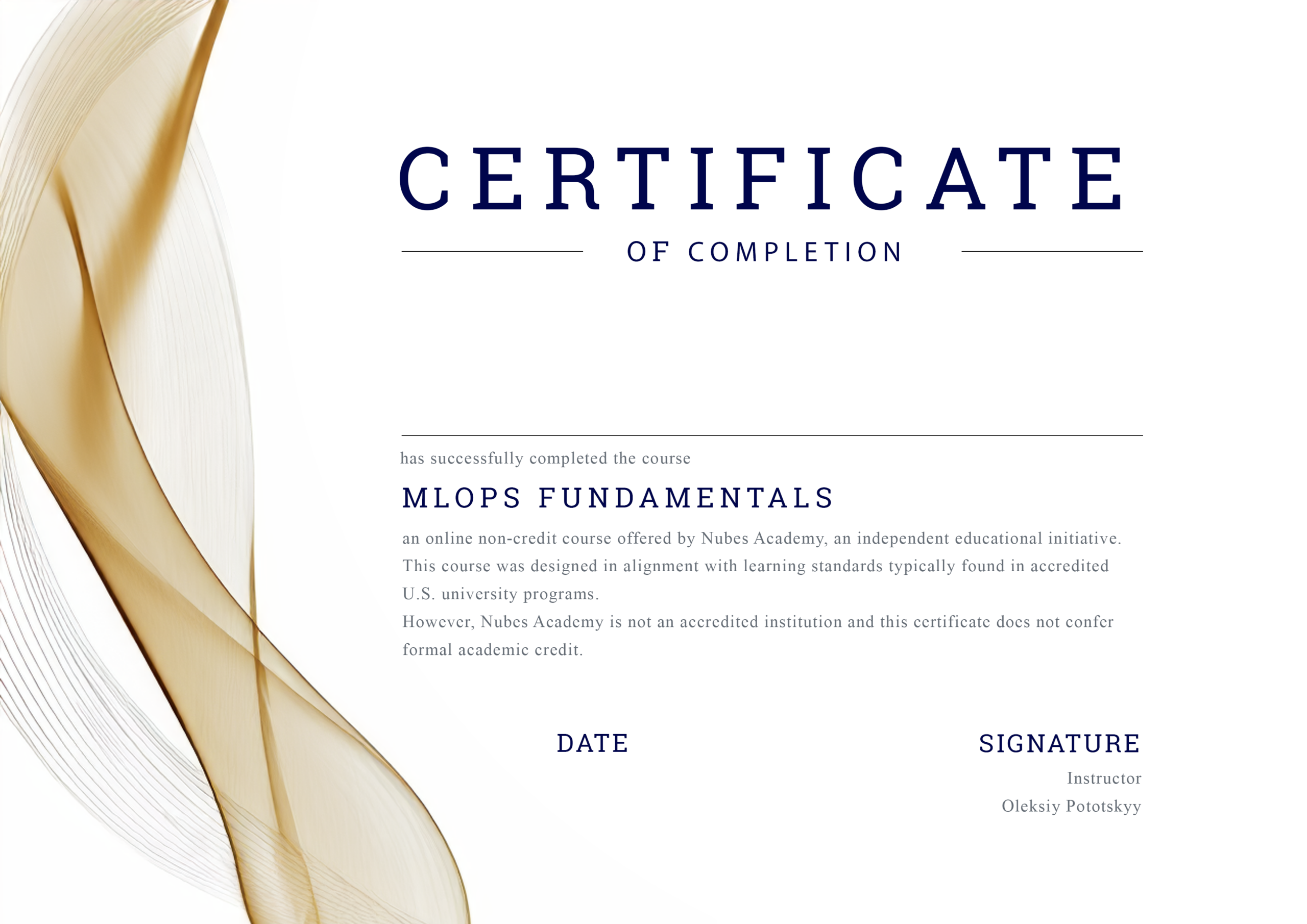
Course credential
Certificate of Completion
Complete Course #8 and earn a Certificate of Completion in Security & Compliance for MLOps — shareable directly to your LinkedIn profile and CV. Security and compliance engineering for ML systems is one of the most in-demand and underserved skills in the field, particularly as the EU AI Act and GDPR enforcement intensifies around AI systems.
Completing Course #8 also unlocks the MLOps Specialization Certificate — awarded on completion of all eight courses. Nubes Academy is developing university accreditation partnerships for the full specialization — the credential is designed to qualify as something recognized beyond a standard online course completion, not just another digital badge.

Your instructor
About Your Instructor
Alex is an Independent Consultant with 20+ years of experience across Software development, DevOps, Architecture, and technical leadership. He developed and delivered Cloud & DevOps curriculum at Master’s Degree level at a university, and continues to work as an active practitioner alongside building Nubes Academy.
What makes Alex’s approach different: his courses are built from data, not assumptions. The MLOps Fundamentals curriculum was designed by analysing what MLOps engineers actually do in production, not by following a generic textbook outline. The result is a course that covers what your future employer expects, explained in a way that makes sense if you already think like an engineer.
If you have a background in IT, and you want to understand where ML fits into the systems you already work with – this course was built for exactly where you are.
Got questions?
Frequently asked questions
Still have questions? Email us directly — we reply within 1–2 business days.
It’s not just skills. It’s your next chapter.
Stay ahead
New courses.
Better price.
Subscribers first.
- Subscriber-only discount on every new course in the MLOps Specialization – before public launch price applies
- Early access to new courses when they go live.
- MLOps job market insights – what skills employers are actually hiring for, based on real job description data
- Practical guides & free content – no noise, only what matters for engineers moving into MLOps
Get early access & subscriber discounts No spam. Unsubscribe any time.
Your data is stored securely and never shared with third parties. · Privacy Policy